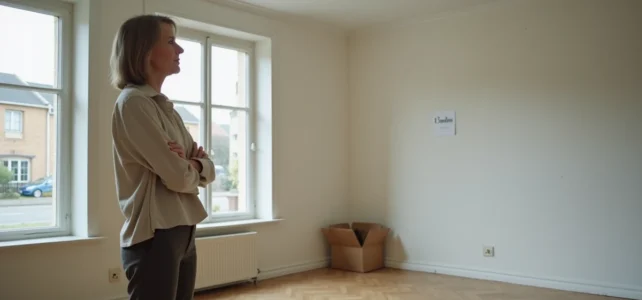
A house put up for sale as part of a divorce in Finistère can remain on the market for months without any serious offers. The problem is not always the property itself. The blockage often stems from an obstacle upstream of the marketing: a disagreement on the price, an unresolved mortgage, or an unclear legal status that drives potential buyers away.
Legal or financial blockage: identifying the real barrier to sale
When a house does not sell in the context of a divorce, the common reflex is to lower the price. This reaction is rarely the right one if the real issue lies elsewhere. Two types of barriers often go unnoticed.
The first is joint liability on the mortgage. As long as both ex-spouses remain co-borrowers, the bank considers them each responsible for the entire loan. A well-informed buyer, or their notary, may hesitate to sign if the mortgage situation is not clarified. The separation of liability or early repayment of the loan should be addressed with the bank before even publishing the listing.
When a house for urgent sale due to divorce in 29 stagnates, the second common barrier is a disagreement between spouses on the terms of the sale. The price, the choice of agency, the schedule for visits: each point of friction delays the effective marketing and sends a negative signal to buyers.
Real estate appraisal in divorce: why one is not enough
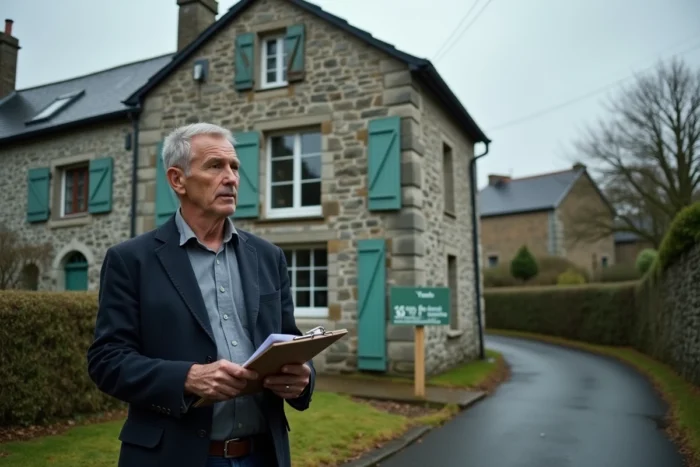
An improperly calibrated starting price is the most direct cause of a property that does not find a buyer. In Finistère, price discrepancies between coastal and rural municipalities can be considerable. A single appraisal, especially if it was done out of complacency or in a conflictual context, does not reflect the actual value of the property.
The concrete recommendation: cross at least two to three independent appraisals. Involving a local real estate agent, a notary, and possibly a land expert allows for a credible range to be obtained. Buyers in Finistère compare available properties in a limited market. A price off by a few thousand euros above the market is enough to deter visits.
If the divorce process drags on for several months, the appraisal also needs to be updated. The real estate market in 29 evolves, and a price set a year earlier may have become obsolete.
Notarial mediation in Finistère: unlocking without going through the judge
When one spouse refuses to sell or contests the price, the usual reaction is to refer to the family court judge (JAF). This procedure works, but it takes time. Several months can pass between the referral and the order authorizing the sale.
A lesser-known alternative exists: notarial mediation. The notary acts as a neutral third party to try to bridge the positions of both spouses on the price, the sales mandate, or the distribution of proceeds. This approach has several concrete advantages:
- The timeframe is often shorter than a judicial procedure, as there is no waiting for a court schedule.
- The cost remains moderate compared to the lawyer’s fees incurred in prolonged litigation.
- The agreement reached in mediation can be directly formalized by a notarial deed, which secures the sale.
In 29, several notarial offices offer this type of support. If the dialogue between ex-spouses is broken but no violence or urgent protection justifies an immediate referral to the JAF, mediation should be attempted as a priority.
Court-ordered sale and JAF authorization: the last resort in joint ownership
When the house is held in joint ownership and one of the owners blocks any action, French law provides a solution. Article 815 of the Civil Code establishes the principle that no one can be forced to remain in joint ownership. In practice, this means that one spouse can ask the judge for permission to sell the property, even without the other’s consent.
The procedure goes through the JAF as part of the divorce. The judge can order the sale if maintaining the joint ownership jeopardizes the common interest. The situations that justify this decision are clear:
- One spouse can no longer afford their share of the loan payments.
- The property is deteriorating due to lack of maintenance, which decreases its value.
- The blockage prevents one of the spouses from finding decent housing.
This judicial route remains a last resort. It involves procedural costs and an unavoidable delay. The goal is to use it as a negotiation lever: in many cases, the mere threat of a referral to the JAF is enough to unlock the situation.

Making the property attractive despite the separation context
A buyer who learns that the sale stems from a divorce may fear a hidden defect, an ongoing dispute, or a last-minute bidding war. These concerns are legitimate and should be anticipated.
The technical file of the property must be complete before the first visit: energy performance diagnosis, state of natural risks, readable title deed, minutes of the general assembly if in co-ownership. A complete file reassures more than a low price.
The physical presentation of the property also matters. A house occupied by only one of the ex-spouses, sometimes in a visibly tense state (the other’s belongings still on site, neglected maintenance), deters buyers. Professional photos and minimal decluttering change the perception of the property.
The real estate market in Finistère, particularly in the areas of Brest, Quimper, and the southern coast, remains active for properties correctly positioned in price. A property that has stagnated for several weeks deserves a complete repositioning, not just a symbolic price drop.