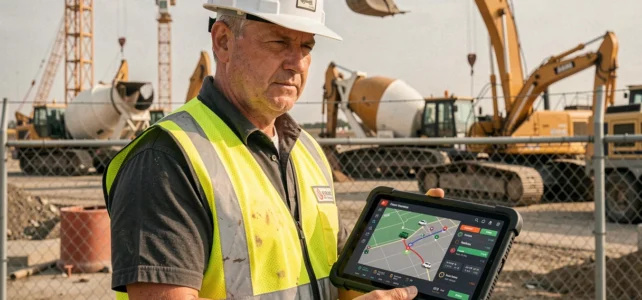
The fleet of vehicles and equipment represents one of the heaviest expense items for a construction company. Excavators, loaders, dump trucks, utility vehicles: each machine deployed on a site generates fixed and variable costs, whether it is in operation or waiting. Fleet management in construction aims to manage these resources to minimize downtime, anticipate breakdowns, and maintain budget control on projects where margins are tightening.
Regulatory Framework of CNIL and Geolocation of Construction Equipment
Before even discussing optimization, any construction company considering geolocating its vehicles must navigate a legal framework that has become stricter. The CNIL recommendation No. 2026-063 of April 16, 2026, published on June 30, 2026, specifically regulates the use of location data in fleets, including for rented or shared vehicles.
This deliberation establishes a clear principle: user consent is mandatory to utilize geolocation data, except when it is strictly necessary for the requested service. Preventing theft or the non-return of a vehicle are among the accepted exceptions. However, continuous tracking of routes or analyzing driving behavior requires a distinct GDPR legal basis.
Beyond CNIL, consulting the CSE remains a legal prerequisite before deploying any geolocation system for employees. A failure to consult exposes the company to a charge of obstruction. This point, often underestimated in medium-sized companies, is crucial for the legality of the entire system.
Understanding these legal constraints is a prerequisite for anyone interested in fleet management in construction with a focus on sustainable compliance.
Equipment Utilization Rates: What the Data Reveals
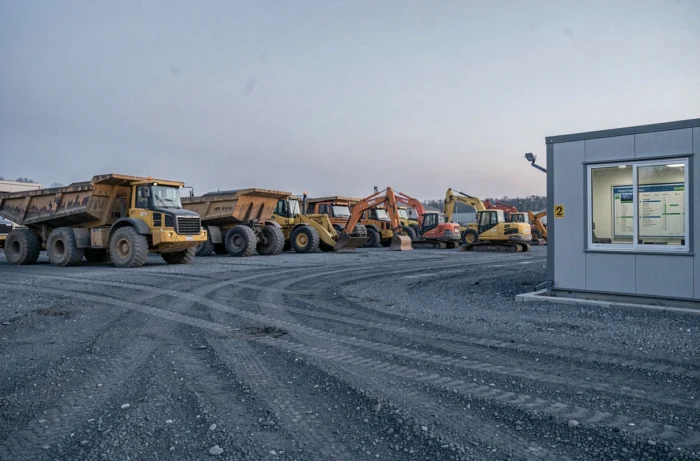
The first lever for optimizing a fleet of equipment is not the purchase of new software. It is measuring the actual utilization rate of each machine. On a typical construction site, a significant portion of the equipment remains idle, sometimes for several consecutive days, due to a lack of coordination between site schedules and equipment availability.
A machine that is not in operation costs almost as much as a machine that is working. Insurance, depreciation, parking fees: fixed costs do not stop when the machine is idle. Measuring the actual usage time against the available time helps to identify redundancies, oversized equipment, or poorly planned transfers between sites.
Sensors and Real-Time Data Collection
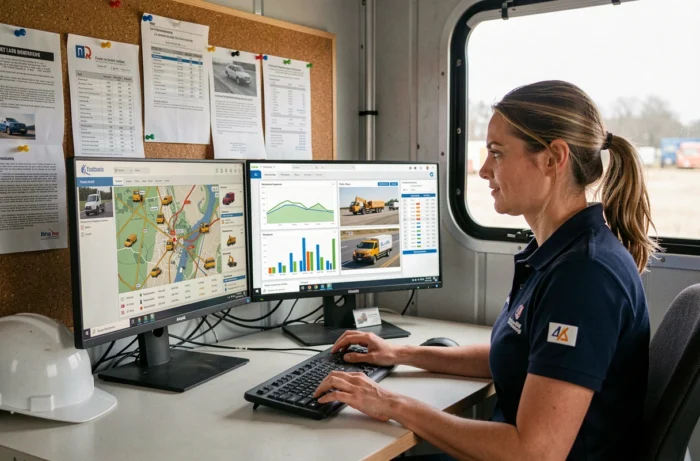
Current fleet tracking solutions rely on onboard devices that report in real-time the position, engine hours, and sometimes fuel levels. This data, aggregated on a web platform, allows for comparison of utilization rates between sites.
Field feedback varies on the reliability of these sensors under site conditions (dust, vibrations, network dead zones). The quality of the data directly depends on the installation and maintenance of the devices, a parameter rarely highlighted by solution providers.
Preventive Maintenance of the Fleet: Reducing Unplanned Downtime
A breakdown on a construction machine does not only result in repair costs. It delays the schedule, requires personnel to organize a replacement, and can incur penalties for delays. Preventive maintenance, driven by usage data, aims to avoid these situations.
- Monitoring engine hours allows for maintenance alerts to be triggered before reaching critical thresholds defined by the manufacturer, reducing the risk of severe mechanical failure.
- A centralized history of interventions in a fleet management tool prevents forgotten oil changes or inspections, which are common when the fleet is spread across multiple simultaneous sites.
- Scheduling downtime for maintenance can be aligned with periods of lower activity on the site, minimizing the impact on overall productivity.
Predictive maintenance (based on trend analysis rather than fixed thresholds) remains promising, but the available data does not yet allow for conclusions about its actual effectiveness in construction, where usage conditions vary significantly from one site to another.
Fuel Costs and Greening the Construction Fleet
Fuel is a significant burden on the operating budget of a fleet of equipment. Tracking consumption by machine and by site allows for the identification of the most fuel-intensive vehicles and the detection of anomalies (overconsumption due to a mechanical defect, prolonged idling).
Optimizing routes and reducing engine idling are two measurable levers to decrease fuel expenses. For the light vehicles in the fleet (vans, liaison vehicles), geolocation also helps to rationalize trips between the depot and sites.
Transition to Low-Emission Equipment
European regulatory pressure is pushing construction companies to incorporate environmental criteria into their fleet renewal. The FNTP mentions a European action plan focusing on electrification, taxation, and greening the fleet.
The available data on the total cost of ownership of electric construction equipment remains fragmented. Initial feedback mainly concerns mini-excavators and forklifts, not heavy earthmoving equipment. The greening of the construction fleet is progressing, but at a pace dictated by manufacturer offerings as much as by the companies’ willingness.
Managing the Construction Fleet Without Overwhelming the Organization with Tools
Deploying a fleet management solution is not limited to installing GPS devices. The tool must integrate into existing processes: site planning, procurement management, cost tracking. An isolated solution that generates dashboards that no one consults adds no value.
- The designation of a clearly identified fleet manager, with dedicated time, is essential for the effective use of the collected data.
- The mobile ergonomics of the platform determines its adoption by drivers and site managers, who neither have the time nor the desire to navigate complex interfaces.
- Compatibility with existing management tools (ERP, planning software) avoids double entry and synchronization errors.
The choice of fleet management software for construction deserves an analysis of actual needs before any commercial demonstration. A fleet of twenty utility vehicles does not require the same solution as a mixed fleet of one hundred machines spread across ten sites. The sizing of the tool to the actual fleet remains the most discriminating criterion, well before the list of features displayed by the vendor.