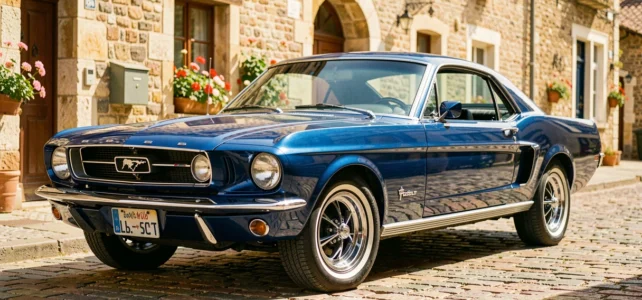
A collector who takes out their Peugeot 204 convertible for a tourist rally in an urban area is faced today with a question that no one was asking five years ago: do I have the right to cross the metropolis without risking a fine? The passion for classic cars is no longer limited to mechanics and aesthetics. It now involves navigating a shifting regulatory framework, specific maintenance constraints, and a market whose benchmarks have changed.
LEZ and classic vehicles: what local exemptions change in practice
It is often said that a classic registration certificate automatically protects against traffic restrictions in Low Emission Zones. This is false. No general national exemption exists for classic vehicles in LEZ. Each metropolis decides by local decree whether or not to allow circulation and sets its own conditions: time slots, perimeter, frequency.
In practice, all metropolises with an active LEZ currently grant an exemption to vehicles registered as classics. Greater Paris, however, is still awaiting the publication of its specific decree. This situation creates concrete uncertainty for collectors in the Île-de-France region who participate in gatherings or exhibitions in central Paris.
A Crit’Air sticker dedicated to classic vehicles is being prepared to simplify checks. It would be distinct from the current classes 0 to 5. In the meantime, it is recommended to systematically check the decree of the crossed metropolis before each outing and to keep a copy of the classic registration certificate in the vehicle.
To stay updated on regulatory news and events related to vintage vehicles, a useful resource is: https://lesvoituresanciennes.net/ which lists practical information for enthusiasts.
Classic registration certificate: conditions for obtaining and real constraints
The vehicle must be at least 30 years old since its first registration to qualify for classic registration. It must be in its original condition or restored to a state close to the original, and present a recognized historical or heritage interest.
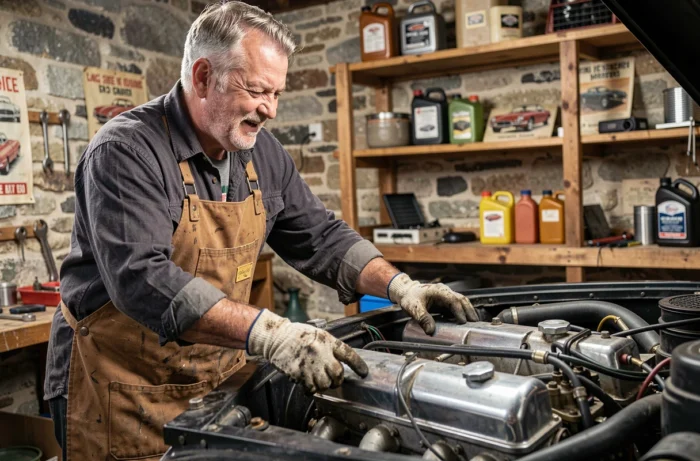
On the ground, feedback varies on this point: some technical inspectors accept minor modifications (exhaust, electronic ignition) while others require near-total compliance with the model identification sheet. Before starting the process, it is advisable to save time by contacting the National Type Workshop, the only body authorized to issue the prior certificate.
What the classic registration certificate changes in daily life
- The technical inspection frequency changes to five years instead of two, with content adapted to the mechanical specifics of classic vehicles.
- The use is theoretically limited to leisure purposes: home-gathering trips, tourist rallies, exhibitions. No regular home-work trips.
- Classic insurance, often cheaper than standard insurance, generally imposes a capped annual mileage and requires parking in a closed garage.
Restoring a classic car: the factors to weigh before buying
Before signing, three elements that condition the total budget are inspected. The bodywork first: structural corrosion on the chassis or floors multiplies the bill by two or three compared to simple surface rust. A magnet passed under the wings quickly detects excessive filler.
The mechanics next. An engine that smokes blue on cold start indicates wear on the valve guides, a common repair but one that immobilizes the vehicle for several weeks with a specialist. Spare parts for popular models (Citroën DS, Renault 4L, Volkswagen Beetle) remain available thanks to a network of specialized manufacturers. For rarer models, the availability of parts determines the feasibility of the project.
Choosing between complete restoration and preservation in condition
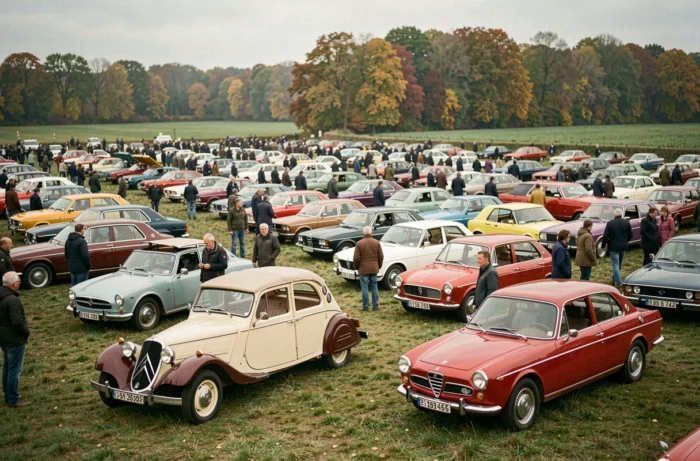
The current market trend values vehicles preserved in their original patina, with documented history, sometimes more than a brand new complete restoration. A “barn find” vehicle with its period paint and a complete maintenance log can attract more interest than a fully restored example without traceability.
Two approaches are distinguished: concours restoration, which aims for a new condition with perfect finishes, and usage restoration, which prioritizes mechanical reliability for regular driving. The latter is significantly cheaper and better suited for those who want to use their classic car, not just display it.
Car gatherings and exhibitions: where to live the passion among collectors
The Rétromobile show at Paris Expo Porte de Versailles remains the major event in France, with its next edition scheduled from February 3 to 7, 2027. It features specialized exhibitors, auctions, and thematic exhibitions that allow for model comparisons and market condition assessments.
Local gatherings are the true glue of the community. Brand clubs, departmental tourist rallies, parts exchange fairs: these events provide reliable contacts for maintenance, identify skilled artisans in the area, and compare the condition of one’s vehicle with that of other examples of the same model.
The Cité de l’Automobile in Mulhouse, which houses the Schlumpf collection, offers another perspective. Here, historical vehicles are observed in a museum context that documents the technical and aesthetic evolution of the automobile over more than a century.
The passion for classic cars plays out on three simultaneous fronts: rapidly evolving regulations, mechanics requiring specific skills, and the community that remains the best safety net for a collector. Checking the local LEZ situation before each outing has become as natural a reflex as checking the oil level.