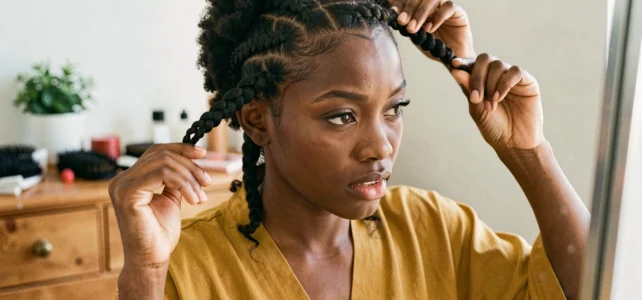
Creating an African braid on short and afro hair without adding synthetic strands raises a specific technical question: at what length does the braiding hold, and which styles actually work without extensions? The answer varies depending on hair density, the fineness of the parting, and the type of braid chosen.
Online content often focuses on box braids with extensions or tutorials for long hair. Short and curly hair, however, adheres to different constraints.
Minimum Length and Texture: What Determines the Feasibility of Braiding
The question is not whether it is possible or impossible. It is about the usable length at the root. Recent sources place the comfort zone around 8 to 10 cm for glued braids without extensions, depending on hair density and texture. Others recommend 10 to 12 cm for better durability.
On type 4B or 4C curly hair, natural shrinkage can reduce the apparent length by half. Hair that seems to measure 5 cm when stretched may actually be 10 cm. This distinction matters because it changes the diagnosis: hair that appears short may be sufficient for braiding if its stretched length allows for a firm grip without excessive tension on the scalp.
Density also plays a role. Very dense hair offers more material per section, which makes it easier for the braid to hold even at modest lengths. Conversely, fine and sparse hair in certain areas (temples, hairline) makes braiding more fragile in those spots, with an increased risk of breakage if the tension is not appropriate.
Several resources detail how to approach the African braid without extensions on Beauty Girl while considering these parameters of length and texture.
Braiding Styles Suitable for Short Afro Hair Without Strands
The current trend favors shorter, finer, and more localized versions of braiding on natural hair. The era of XXL braids as the only reference is giving way to styles that utilize the actual length of the hair.
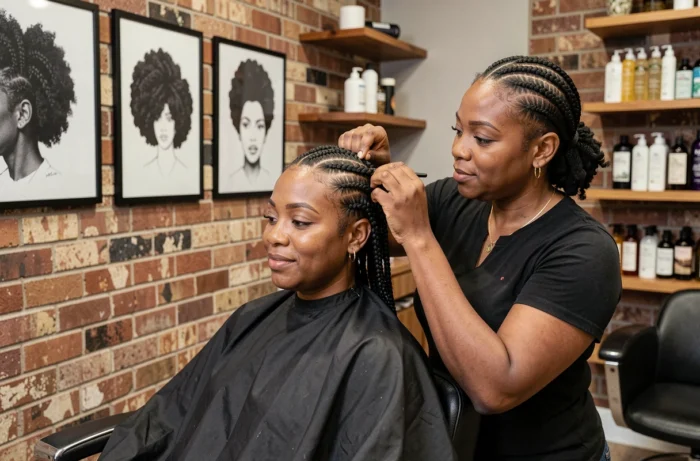
Short Cornrows and Geometric Patterns
Cornrows (flat braids) remain the most suitable style for short hair without extensions. The principle: braid flat against the scalp while gradually incorporating small sections of hair. At a length of 8 to 10 cm, cornrows hold well if the parting is fine and consistent.
Fine geometric patterns enhance short hair better than thick braids. Straight lines, zigzags, curved patterns: the precision of the design on the scalp becomes the main aesthetic element, not the length of the braid itself.
Flat Twists and Short Twists
Flat twists require less tension than traditional three-strand cornrows. They work with two twisted strands, making them gentler on the scalp and accessible at slightly shorter lengths.
Free twists (not glued) are another option, provided the hair has enough natural grip to maintain the twist. Curly hair, due to its texture, holds better than straight hair, which partially compensates for the reduced length.
Partial Braids and Hybrid Styles
Braiding only one area (sides, top, hairline) and leaving the rest free allows for bypassing the issue of areas where the length is insufficient. A common style: cornrows on the sides with the top left in a twist-out or free afro. This type of mixed hairstyle adds dimension without forcing braiding over the entire head.
Preparing Short Hair Before Braiding: A Streamlined Protocol
Recent recommendations lean towards a lighter and more targeted preparation protocol, far from the overload of products sometimes advised for long hair. On short hair, too much product weighs down the strand and makes it slippery, complicating the grip during braiding.
- Wash with a mild shampoo to remove residue without stripping the scalp. A clean but not dry scalp makes sectioning easier.
- Detangle on damp hair with a wide-tooth comb or fingers, section by section, starting from the ends to the roots.
- Apply a light layer of moisturizer (water and vegetable oil spray, or fluid leave-in) without saturating the fiber. The hair should be soft but not wet at the time of braiding.
- Slightly stretch the hair if needed (banding method, loose braids the night before) to gain usable length without resorting to heat.
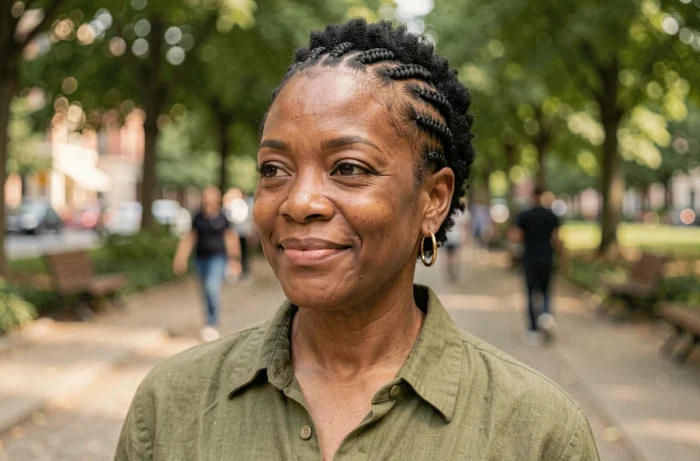
Maintenance and Tension: Protecting the Scalp on Short Braided Hair
The main issue with braiding on short hair is not the hold, but the tension. The shorter the hair, the stronger the temptation to tighten the braid for it to grip. This reflex causes exactly the opposite effect in the medium term: repeated tension on the same areas weakens the follicle and can lead to traction alopecia, especially on the hairline and temples.
Current recommendations emphasize several precautions:
- Regularly change the location of partings and the direction of braiding from one hairstyle to another, to avoid always stressing the same roots.
- Take breaks between two braided hairstyles. Continuously wearing cornrows without interruption for months increases the risk of breakage in tension areas.
- Protect the braids at night with a bonnet or satin pillowcase to limit friction and preserve the neatness of the parting.
- Never braid weakened or brittle hair. If the hairline shows signs of thinning, allow the area to rest.
The lifespan of a braided hairstyle without extensions on short hair is naturally shorter than with extensions. Generally, expect one to two weeks depending on the style and daily activity, compared to several weeks for box braids with strands.
Field feedback varies on the ideal frequency of washing while wearing braids. Some hairstylists recommend a light rinse after a week, while others advise against any shampoo to maintain hold. The most common compromise remains a cleansing spray applied to the scalp between the braids, without manipulating the hairstyle.
Adopting the African braid on short and afro hair without extensions means working with the available material rather than against it. The result depends less on length than on the precision of the parting, the choice of style, and the care of the scalp between two hairstyles.