
The average size of new cars sold in Europe has continued to grow since the early 2000s, according to Transport & Environment. Labels such as “city car” or “urban SUV” no longer guarantee a compact footprint. Two models in the same segment can differ significantly in length, width and, above all, weight—differences that can radically change how they work in everyday use. Understanding a car’s dimensions starts with knowing which measurements to consider and which to ignore based on your actual needs.
Actual vehicle width: the figure technical specifications leave out
Most manufacturers publish body width with the mirrors folded in. This figure does not reflect the space the car actually takes up when parked.
Width with the mirrors extended commonly adds 20 to 30 centimetres to the catalogue figure. A compact SUV listed as 1.80 m wide often takes up more than two metres in reality, leaving little room to open the driver’s door in a garage.
Before buying, the most reliable approach is to physically measure three things: the width of the entrance (gate, pillars or post), the distance between the garage’s interior walls, and the space needed to open the door wide enough to get out of the vehicle. Comparing these measurements with the dimensions of a car listed in its technical specifications can help you avoid an unpleasant surprise on delivery.
One often-overlooked detail: the doors on saloons and estate cars swing out in an arc, requiring more lateral clearance than the sliding doors on an MPV. The vehicle may be the perfect length for the parking space, but if the doors only open halfway, getting in and out becomes uncomfortable.

Vehicle weight and city parking: a constraint that goes beyond size
Since some French cities began basing the cost of resident and visitor parking on vehicle weight, weight has become a factor in choosing a car, just like length. Paris led the way, and other municipalities are considering similar schemes.
This is particularly important for electric models. Citepa notes that electric cars sold in France are, on average, significantly heavier than their petrol and diesel equivalents, partly because the range still focuses on larger segments and high-capacity batteries. A compact electric SUV can therefore weigh several hundred kilograms more than a combustion-engine saloon of the same length.
Weight alone does not tell you a vehicle’s exterior dimensions. A short but heavy car (with a bulky battery and reinforced structure) may cost more to park than a longer but lighter combustion-engine estate. Checking the kerb weight on the vehicle registration certificate (section G1) is a good habit before comparing parking rates in your municipality.
Catalogue dimensions versus real-world use: what the figures don’t tell you on their own
Average figures by segment (city car, compact, SUV) provide a rough guide, nothing more. Regional data shows that average car length varies across France, suggesting that local conditions (narrow streets, angled parking and suburban distances) influence choices far beyond simple marketing categories.
Wheelbase and passenger space: a direct but incomplete link
The wheelbase—the distance between the two axles—largely determines rear passengers’ legroom. Two cars of the same overall length can have very different wheelbases, depending on the length of their front and rear overhangs.
A long wheelbase also improves high-speed stability and ride comfort. On the other hand, it increases the turning circle, making manoeuvres in town more difficult. For mainly urban driving, a short wheelbase and a tight turning circle matter more than a shorter overall length.
Boot capacity: advertised litres versus usable space
Boot capacity in litres is measured using the VDA standard, which calculates how many standardised rigid blocks fit inside. The shape of the boot matters just as much as its stated capacity. A high loading lip, narrow opening or recessed floor reduces the space you can actually use. Whether you can fit a long item such as a bicycle or flat-pack furniture depends on the available length with the rear seats folded down, not the figure in litres.
Choosing the right model: factors to weigh up before buying
A common mistake is to compare only the length of two models. In practice, you need to consider several factors at once.
- Width with the mirrors extended compared with the width of your garage or usual parking space, allowing for enough room to open the doors.
- Kerb weight (section G1 of the vehicle registration certificate) compared with local parking rules, particularly in areas with weight-based pricing.
- Wheelbase and turning circle together, especially if your daily journeys involve frequent U-turns or underground car parks with tight bends.
- Overall vehicle height compared with the clearance in the underground car parks you use, checking the signs at the entrance to each one.
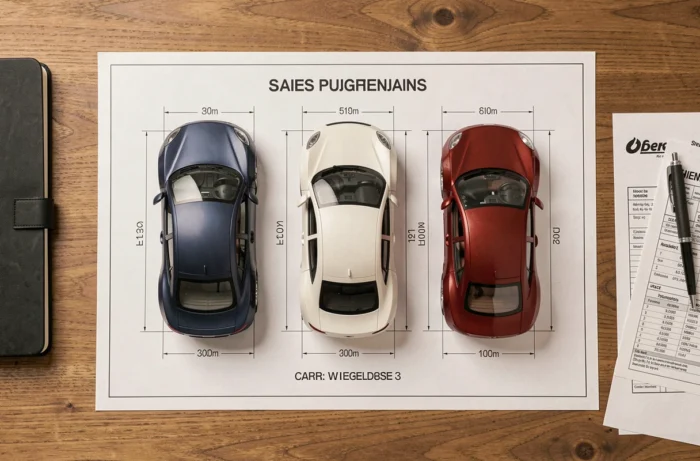
Even a basic comparison table of your own is more useful than skimming a manufacturer’s specifications. Listing your garage measurements alongside those of the car you’re considering (including the mirrors and, where applicable, roof bars) helps turn abstract figures into a practical decision.
A vehicle’s marketing category does not predict whether it will suit a particular use. A compact SUV may be too wide for a 1970s garage, while a compact saloon with a long wheelbase can sometimes offer more interior space than a larger crossover. Measure, compare and try it out in person: it’s the only method that works every time.