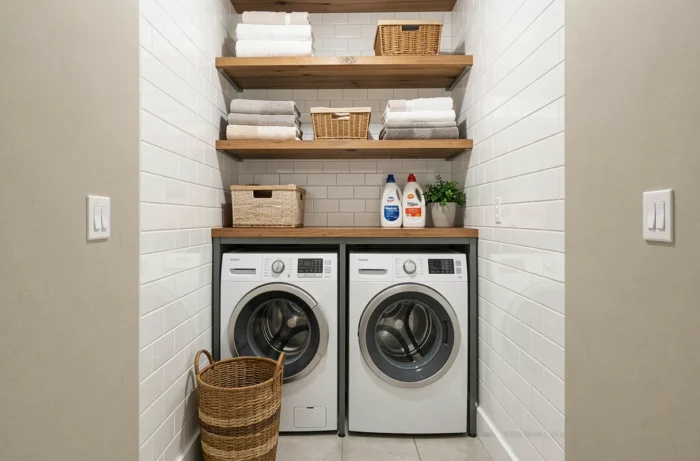
In an apartment where the laundry area is little more than a corner of the hallway, dirty clothes quickly end up piled on the washing machine because there’s no room for a hamper. This kind of constraint means rethinking every inch, and choosing the right appliances matters just as much as choosing the right furniture. A good laundry room layout starts with a simple question: should you get two separate machines or a single washer-dryer, and what difference does that make in everyday life?
Washer-dryer or stacked washer and dryer: what the footprint doesn’t tell you
When space is limited, a washer-dryer seems like the obvious solution. One appliance, one connection, one footprint. But the reality of using one is more nuanced.
A washer-dryer’s drying capacity is often lower than its washing capacity. You can wash a full load, but the drying cycle can only handle some of those clothes. In practice, to run a continuous wash-and-dry cycle, you need to remove some clothes between the two stages or accept that they won’t dry completely.
A stacked washer and dryer (one on top of the other using a stacking kit) solves this problem: each appliance can run at full capacity. You get the same floor space savings as with a washer-dryer, while keeping two separate capacities and the option to start a wash while a drying cycle is running.
For a household of three or more, a stacked setup can save a significant amount of time over the course of a week. For a couple in a studio apartment, a washer-dryer may be enough, provided you check the drying capacity on the energy label and don’t rely solely on the washing capacity. Ideally, consult a dedicated guide to laundry room layouts with a washing machine to see the possible configurations for your available space.
Energy labels and repairability: two things to check before you buy
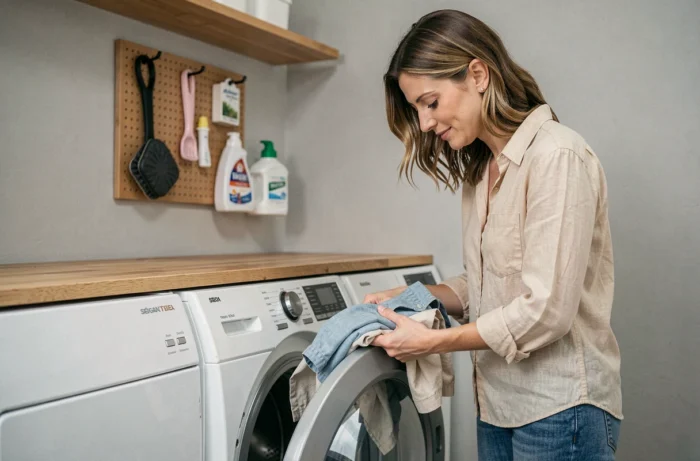
Energy labels for tumble dryers have been revised by the European Commission in recent years. The old ratings are no longer directly comparable with the new ones. Before buying, make sure the appliances you’re comparing carry the same version of the label, or you could end up with a misleading comparison.
The tumble dryer label now provides information on energy consumption per 100 cycles, programme duration and condensation efficiency. These three figures help you weigh everyday convenience against actual energy costs—an aspect rarely covered in laundry room design advice.
Repairability as a deciding factor
European ecodesign rules require certain spare parts to remain available for several years after the last unit of a washing machine or washer-dryer model is placed on the market. A repairable appliance costs less over ten years than a cheaper, disposable one.
A repairability rating is expected to appear on the relevant appliances soon. Considering this factor now can help you choose a machine whose spare parts will remain available.
- Check the version of the energy label before comparing two tumble dryers or washer-dryers.
- Compare drying programme durations: a shorter cycle may use more energy per cycle, but it frees up the machine sooner.
- Choose a manufacturer that commits to keeping spare parts available beyond the regulatory minimum.
- Check the tumble dryer’s condensation efficiency: poor efficiency releases more moisture into the room.
Ventilation and humidity: the pitfall of a ventless tumble dryer
A heat pump tumble dryer works without an exhaust duct to the outside. You might think that means there are no installation requirements. That’s not the case.
Even in a closed-loop system, a condenser or heat pump tumble dryer gives off heat and needs a minimum level of ventilation. The manufacturer’s instructions generally specify how much clearance to leave around the appliance and how to ventilate the room. In a closed cupboard or a windowless nook, residual moisture builds up and encourages mould on walls and seals.
Two practical solutions:
- Install a low-level vent and a high-level vent if the laundry area is enclosed, even if it’s small. Natural airflow is enough in most cases.
- Make sure the tumble dryer’s water collection tank is easy to access, or connect the drain directly to an existing trap to avoid unnoticed overflows.
If the machines are stacked, the collection tank will be higher up. Check that you can reach it without a step stool; otherwise, opt for direct drainage.
Storage and organization: make use of the walls, not the floor
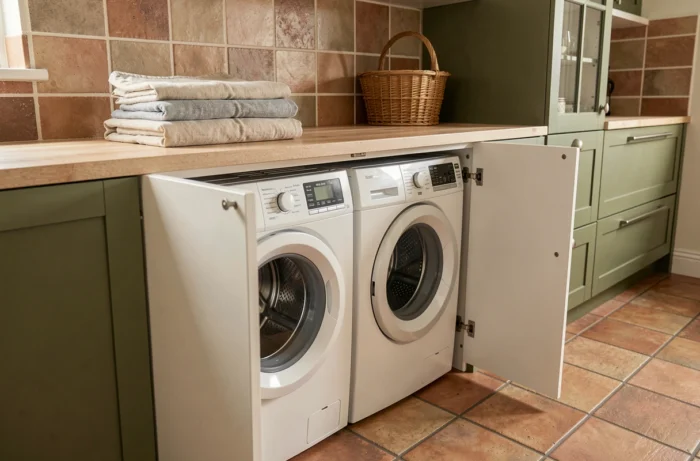
Once the appliances are in place, there’s often very little floor space left. The walls are where storage makes all the difference.
Above the machines
The space between the tops of the appliances and the ceiling is rarely put to use. A shelf installed at the right height can hold laundry detergent, a basket of clothespins and replacement filters. Avoid wall cabinets that are too deep, as they can get in the way of loading a top-loading washing machine.
Alongside the machines
A narrow rolling cart (15 to 20 cm wide) can fit between the machine and the wall. Use it to hold laundry baskets sorted by color. Hooks on the door or adjacent wall can hold a bag for delicates or a folding ironing board.
A countertop above the machines makes all the difference. A melamine board cut to size creates a stable surface for folding clothes. Add a small raised edge at the back to stop socks from slipping behind the appliances.
Making the most of a laundry room has less to do with its size than with the choices you make beforehand: the right appliance for your needs, suitable ventilation and storage that makes use of every available wall. The rest comes down to folding the laundry at the right time.