We have a lime tree trimmed that overhangs the neighbor’s roof, we receive the invoice, and at the time of filling out the income tax return, the question arises: can this amount reduce the tax? The answer entirely depends on the exact nature of the intervention and the status of the service provider. In 2024, the tax credit for personal services covers certain gardening work, but tree pruning only falls under the scheme under very restrictive conditions.
Pruning at a reachable height: the only intervention eligible for the tax credit
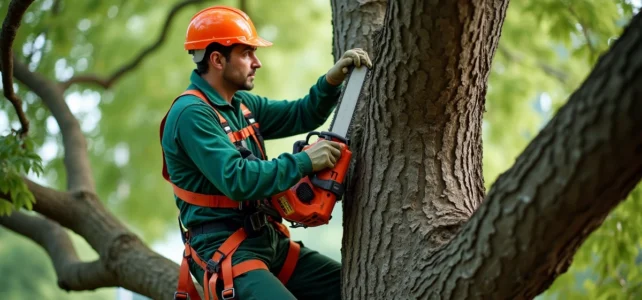
The tipping point lies in the height of the intervention. The Ministry of Economy has clarified that the pruning and trimming of a tree are only eligible for the tax credit if it is regular maintenance performed at a reachable height, without the need for the worker to climb the tree or use ropes, harnesses, or removal trucks.
In practical terms, this refers to cutting low branches with shears or clippers that are accessible from the ground. As soon as a pruner climbs the tree, uses a platform, or a chainsaw, the operation falls outside the scope of “small gardening” and the tax credit no longer applies.
This distinction often surprises people because, in common language, “pruning” specifically refers to work at height. Before requesting a quote for tree felling and pruning, it is better to clarify with the provider the exact nature of the planned intervention and check if it remains within the tax perimeter.

Gardening tax credit 2024: ceilings and declaration conditions
The scheme is based on the 50% tax credit for personal services. It concerns individuals, whether taxable or not (a non-taxable person receives a payment from the public treasury).
Applicable spending ceilings
Eligible small gardening expenses are capped at 5,000 euros per year and per tax household. This ceiling can be increased based on dependents within the household. For households with a member over 65 years old, the spending ceiling can reach 6,000 euros.
The tax credit applies to 50% of the amount actually paid, within the limit of this ceiling. Returns vary on this point depending on family situations, so it is necessary to check one’s specific case on the tax website.
Provider status: a non-negotiable criterion
The professional must be registered as a personal service provider with the DIRECCTE (or DREETS depending on the region). Without this approval or registration, the invoice does not entitle one to anything, even if the intervention remains at a reachable height.
A landscaper in a micro-enterprise benefiting from the VAT exemption (article 293 B of the CGI) invoices without VAT, which modifies the total amount on which the tax credit is calculated. Therefore, it is always checked that the provider mentions their SAP registration number on the invoice.
Deductible gardening work: what qualifies and what doesn’t
To clarify, here is what the scheme covers and what it excludes in a garden:
- Lawn mowing, leaf collection, manual weeding: eligible, as these are routine maintenance tasks without heavy equipment.
- Trimming hedges and shrubs at a reachable height: eligible, provided that the intervention does not require a ladder or specialized motorized equipment.
- High pruning with climbing, platform, or chainsaw: not eligible. This operation falls under specialized work, not small gardening.
- Tree felling: not eligible. This is a service for heavy forestry or landscaping work, completely outside the scope.
- Light ground clearing: eligible, as long as it remains manual or with small tools.
Felling and complex pruning are never covered by the tax credit, even if the invoice comes from an approved personal service provider.
Landlord: deduction of rental income for pruning
For owners who rent out a property, the tax logic changes completely. We no longer talk about a tax credit but about detection of expenses on rental income.
Maintenance work on the outdoor spaces of a rental property can, in some cases, be deducted as property expenses. Pruning trees located on the rented property then falls into the category of maintenance expenses, provided that the property is rented and declared under the actual taxation regime.
Under the micro-property regime, the standard deduction theoretically covers these costs, but they cannot be deducted line by line. It is under the actual regime that the deduction becomes most interesting, especially when the work represents a significant amount.
Case law and precautions
Official texts do not explicitly mention every type of outdoor work. Some decisions have validated the deduction of pruning expenses as maintenance charges for a rented property, but the tax authorities may contest if the intervention resembles an improvement rather than maintenance. Keeping the detailed invoice and proof of the recurring nature of the maintenance remains the best protection in case of an audit.

Immediate advance and declaration: concrete steps
Since the establishment of the immediate advance service by URSSAF, one can benefit from the tax credit directly at the time of payment, without waiting for the income tax return of the following year. The provider must be registered in the scheme, and the individual must activate the service on their URSSAF space.
For the classic declaration, eligible gardening expenses are reported in box 7DB (personal services) of form 2042 RICI. The total amount paid in the year is entered there, within the limit of the applicable ceiling.
- Check that the provider is registered SAP before signing the quote.
- Request an invoice mentioning the precise nature of the intervention (pruning at a reachable height, without climbing).
- Keep all receipts for three years, the duration of the tax recovery period.
The boundary between deductible pruning and non-eligible pruning lies in an operational detail: the height of intervention and the equipment used. The same tree can generate an invoice that qualifies for the tax credit (low pruning with shears) or an invoice with no tax advantage (climbing pruning with removal). Asking the provider before the intervention avoids unpleasant surprises at the time of declaration.