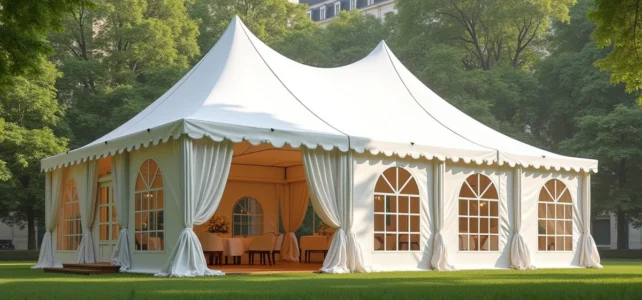
Organizing a tent reception in Paris involves solving an equation with multiple unknowns: the available space, the often capricious Parisian weather (especially between May and September), the safety standards specific to temporary structures, and coordination with various service providers. Each of these parameters impacts the choice of model, budget, and setup schedule.
Weather Resistance: The Criterion That Quotes Often Don’t Detail Enough
Most providers present their tents by format (gable, pagoda, arch structure) and by surface area. Details on weather resistance are often relegated to an appendix, even though it is the parameter that determines the smooth running of an outdoor reception in Paris.
Event professionals recommend checking three technical elements before signing any contract: the wind resistance of the structure, the waterproofing of the fabric, and the type of anchoring planned for the ground. A grassy area in a private garden in the 16th arrondissement is not treated the same as a paved courtyard in the Marais. The fastening system (concrete weights, long stakes, bolted plates) must be adapted to the surface.
Modular side closures allow for a quick switch to a closed configuration if rain arrives. This point should be negotiated right from the quote: some offers charge extra for side walls, while others include them. The difference in the final amount is not negligible.
For summer receptions, managing heat is as important as protection against rain. Professional recommendations include setting up misting systems, fans, and shade sails around the tent, to be integrated into the layout plan as soon as the reservation is made. For cool evenings, outdoor space heaters complement the setup.
Anticipating the tent rental for receptions in Paris while considering these climatic constraints avoids unpleasant surprises on the big day.
Safety and Compliance of Temporary Installations in Paris
A temporary structure hosting the public is subject to regulatory obligations. In Paris, reception tents fall into the category of establishments receiving the public (ERP) of type CTS (tents, marquees, and structures) as soon as they exceed a certain capacity threshold.
Specifically, the provider must provide a certificate of compliance for the structure, a validated layout plan, and, depending on the size, a review by the safety commission. Field feedback shows that many individuals are unaware of these obligations when organizing a wedding or birthday in a private garden. The fact that the event is private does not automatically exempt these checks.
Three documents to request from the rental company before signing:
- The safety register of the structure, mentioning inspection dates and the allowable wind load
- The professional civil liability insurance certificate covering setup, operation, and dismantling
- The evacuation plan adapted to the chosen configuration, with the positioning of emergency exits
A provider who refuses to provide these documents or presents them as optional sends a warning signal. Compliance is not a decorative option.
Coordination of Caterer, Set Designer, and Technician: The True Success Factor
The tent is just a shell. What transforms this shell into a functional reception venue is the collaboration between the caterer, the set designer (or decorator), and the sound and lighting technicians. In Paris, where delivery times and access constraints are tighter than in the provinces, coordination among providers determines the quality of the event.
The caterer needs to know the exact location of electrical connections and water points. The set designer must know what types of attachments are allowed on the structure (hanging chandeliers from a PVC fabric is not trivial). The lighting technician intervenes after the furniture is set up but before the arrival of floral arrangements. This sequencing cannot be improvised.
Event providers offering turnkey packages integrate this coordination into their service. For those who assemble their own teams, a shared timeline remains the best tool. It sets the delivery slots, setup times, and access hours for each trade.

Surface Area and Layout of the Tent: Think in Terms of Use, Not Raw Square Meters
Calculating the necessary surface area by dividing the number of guests by a standard ratio (like one square meter per standing person) gives a rough estimate, not a layout plan. Several elements eat into the usable area:
- The central poles (on certain models of traditional tents) that create dead zones for table placement
- The space dedicated to the buffet or catering service, often underestimated
- The dance floor, which requires a specific flooring and sufficient clearance
- The pathways between tables, essential for service and evacuation
A pole-free tent offers a significantly larger usable area than an equal raw surface. Free-span structures (arched or aluminum frame) allow for more flexible arrangements, even though their rental cost is generally higher.
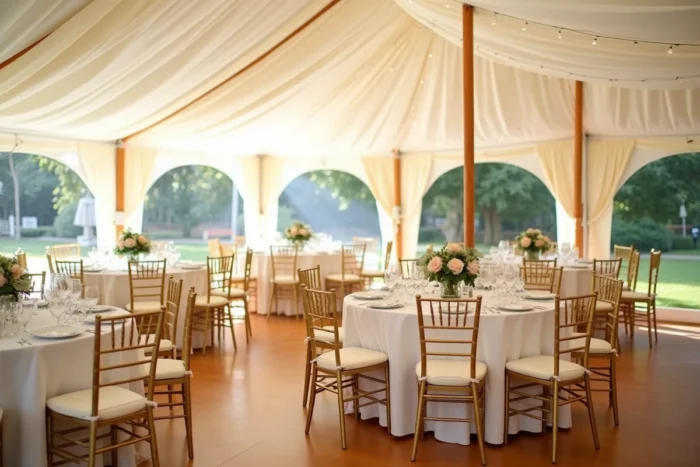
The choice of fabric also affects the interior ambiance. A crystal fabric (transparent) brings in natural light during the day, while an opaque PVC fabric facilitates artificial lighting for an evening event. The two options have different scenic effects and thermal behaviors.
Site Terrain and Accessibility in Paris
In Paris, access to the setup location poses a specific constraint. An event structure delivery truck often measures more than twelve meters. Narrow streets, carriage doors, and inner courtyards sometimes require manual transfer or the use of smaller vehicles, which extends setup time and can increase the quote.
Checking the width of access points, the load-bearing capacity of the ground, and the presence of buried networks (pipes, cables) before the provider’s technical visit saves time for both parties. The prior technical site visit remains the only reliable guarantee to validate the feasibility of an installation.