
Paracetamol is one of the most common medications in a travel kit. However, transporting this substance to Norway raises specific questions: what is the maximum quantity allowed, what documents are required, and what are the differences compared to other substances in the same medicine cabinet? Norwegian regulations clearly distinguish between paracetamol alone and combined formulations, and this distinction radically changes travel preparation.
Paracetamol alone or combined with codeine: two distinct import regimes
The most common confusion concerns medications containing paracetamol combined with a narcotic substance. Pure paracetamol (Doliprane, Dafalgan, Efferalgan) falls under the general regime for non-prescription medications. Tablets combining paracetamol and codeine (such as Codoliprane) or paracetamol and tramadol are subject to narcotic substance regulations.
The Norwegian Medicines Agency (DMP) applies different thresholds based on the category. To find the travel tips with Voyagoo, one must first understand this fundamental distinction that conditions all documentary preparation.
| Criteria | Paracetamol alone | Paracetamol + narcotic substance (codeine, tramadol) |
|---|---|---|
| Maximum import duration | 3 months of treatment | 30 days of consumption (INCB, updated 01/14/2025) |
| Prescription required | No, unless high volume | Yes, mandatory |
| Schengen certificate required | No | Yes, for Schengen countries |
| Original packaging | Yes | Yes, with readable labeling |
| Risk in case of non-compliance | Possible confiscation | Confiscation + administrative sanctions |

30-day threshold for narcotics: what the INCB specifies for Norway
Most travel guides mention the general rule of three months of treatment without distinguishing between categories of substances. The table from the International Narcotics Control Board (INCB), updated as of January 14, 2025, sets a more restrictive ceiling for narcotics and psychotropic substances: the equivalent of 30 days based on the prescriber’s dosage.
This threshold applies to international travelers not residing in Norway. Beyond 30 days, special authorization must be obtained before departure. This nuance has direct consequences for individuals treated with level 2 or 3 analgesics on a daily basis.
In contrast, paracetamol alone is not subject to this 30-day ceiling. The limit remains set at three months of treatment in the original packaging. Specifically, for a two-week stay, bringing two or three boxes of 1000 mg paracetamol poses no difficulty, provided the pharmaceutical packaging remains intact.
Schengen certificate and prescription: what documents to prepare before departure
Norway is part of the Schengen area, which activates a specific documentary framework for certain medications. The Schengen certificate, issued by the Regional Health Agency (ARS) in France, concerns exclusively narcotics and psychotropics. It does not apply to paracetamol alone.
For travelers carrying codeine-containing paracetamol or other combinations containing narcotics, the recommended procedure includes:
- A prescription written by the attending physician, mentioning the international nonproprietary name (INN) of the medication, the dosage, and the duration of treatment
- The Schengen certificate validated by the ARS, to be requested several weeks before departure to anticipate processing times
- Keeping all medications in their original packaging, with the leaflet and visible pharmacist labeling
The ANSM reminds that for travel outside Schengen, a transport authorization may also be necessary. Since Norway is a member of the Schengen area (without being a member of the European Union), the Schengen certificate prevails for controlled substances.
Translation of the prescription: mandatory or not?
The DMP accepts prescriptions written in Scandinavian languages, English, or German. A prescription in French is not explicitly mentioned in the list of languages accepted by Norwegian authorities. Having the prescription translated into English by the doctor or having an English summary reduces the risk of misunderstanding during a customs check.
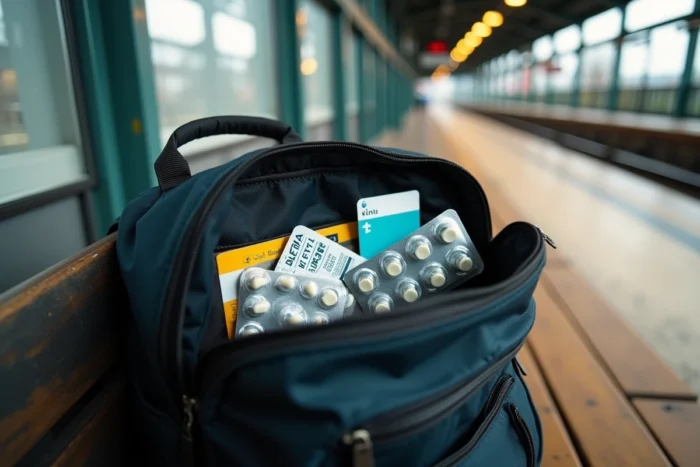
Buying paracetamol on-site in Norway: pharmacies and points of sale
Norway allows the sale of paracetamol outside of pharmacies, in certain authorized stores (supermarkets, gas stations). The available over-the-counter packaging is limited in dosage and quantity per box, which is a notable difference from France.
Norwegian pharmacies (apotek) dispense larger packaging, sometimes upon presentation of an ID. The price of paracetamol in Norway is significantly higher than in France, which encourages most travelers to bring their own stock.
- Emergency pharmacies exist in major cities (Oslo, Bergen, Trondheim), but their hours are more limited than those of French pharmacies
- Supermarket sales only concern small packaging of low-dose paracetamol
- No narcotic substance (codeine, tramadol) is accessible without a local Norwegian prescription
Norwegian customs control on medications: what triggers a check
Norwegian customs (Tollvesenet) primarily target unusual volumes and medications removed from their packaging. Transporting loose tablets or in a pill organizer without original packaging significantly increases the risk of inspection.
Customs officers may request justification for each medication transported, including for uncombined paracetamol. An intact package with the leaflet in French is generally sufficient to dispel doubt. For narcotic substances, the absence of a prescription or Schengen certificate may lead to immediate confiscation of the product.
Transporting medications in carry-on luggage remains the standard recommendation. A delayed or lost checked bag deprives the traveler of their treatment, and temperature-sensitive medications are subjected to uncontrolled storage conditions in the hold.
The distinction between paracetamol alone and narcotic formulations remains the central point of vigilance. A traveler carrying only pure paracetamol in its original packaging, for a reasonable duration, will not encounter difficulties. It is the addition of codeine or tramadol in the travel kit that activates the entire Norwegian regulatory framework.