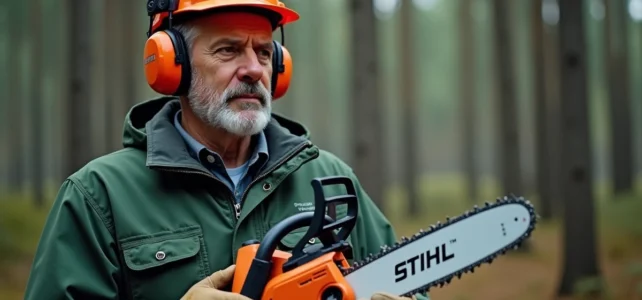
Between a failed cold start that floods the engine and a clean procedure that starts the chain in three pulls, the difference rarely lies with the machine. It lies in the order of actions and the understanding of what each command mechanically triggers. This guide details the starting sequence of a Stihl gas chainsaw, the mistakes that cause flooding, and the safety checks that precede the first pull.
Chain brake and decompression valve: two mechanisms often confused
Most online guides list the starting steps without explaining why each action matters. Two elements deserve special attention because they concentrate the majority of handling errors.
The chain brake is not a comfort device. It physically blocks the rotation of the drive sprocket. By pushing the front hand guard forward, you prevent the chain from turning during the starting phase. Forgetting this action exposes you to a chain start at the very first combustion, while the machine is still on the ground.
The decompression valve, present on medium and larger displacement models, releases some of the compression in the cylinder. By pressing it before pulling the starter, the mechanical resistance decreases significantly. Knowing how to start a Stihl chainsaw easily first involves mastering these two controls, well before touching the choke.
| Component | Mechanical Function | Consequence if Forgotten |
|---|---|---|
| Chain Brake | Blocks the drive sprocket | Immediate chain rotation at startup |
| Decompression Valve | Reduces compression in the cylinder | Harder pulls, fatigue of the starter |
| Fuel Pump (primer) | Delivers the mixture to the carburetor | Laborious starting, multiple pulls |
| Choke (starting flap) | Enriches the air/fuel mixture | Engine stalls or refuses to start cold |
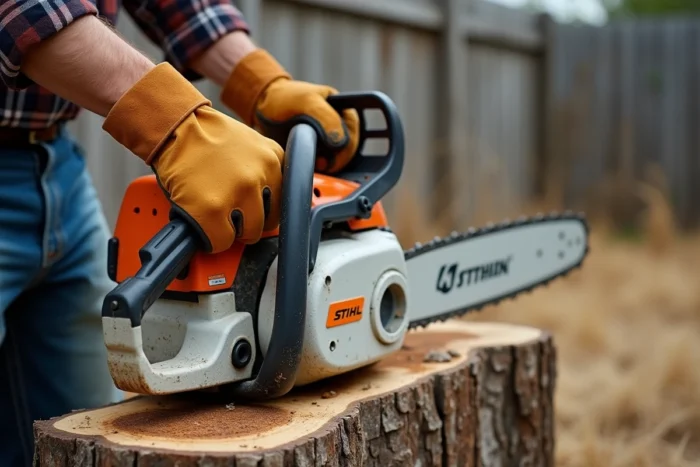
Cold starting sequence of a Stihl gas chainsaw
A cold start follows a precise order. Each step conditions the next, and reversing two actions is enough to flood the engine.
- Remove the guide guard, place the machine on stable ground, and engage the chain brake by pushing the hand guard forward.
- If the chainsaw has a decompression valve, press it. If it has a fuel pump (translucent bulb), press it at least ten times until you see fuel circulating in the return hose.
- Set the combined control lever to the cold start position (choke closed, often symbolized by a fully closed flap). This enriches the mixture to compensate for the low cylinder temperature.
- Firmly hold the front handle, secure the machine to the ground with your foot in the rear handle, and pull the starter in a quick motion until you hear the first combustion (a characteristic “pop”).
- As soon as you hear this first combustion, reposition the control lever to the warm start position (half-choke). Pull the starter again. The engine should run.
- Accelerate briefly to exit the starting regime, then disengage the chain brake by pulling the hand guard towards you.
The most common trap lies between the fourth and fifth steps. If you continue to pull with the choke closed after the first combustion, the engine floods due to excess fuel. Switching to half-choke after the first “pop” is the decisive action.
Warm start: what changes
When the engine is already at temperature (recently stopped), the sequence shortens. No need for a fuel pump or closed choke. The control lever remains in the operating position, and one or two pulls are sufficient.
The decompression valve must still be activated at each start on models that have one. This reflex protects the starter mechanism in the long term.
Engine flooding: diagnosis and recovery
A flooded engine is the direct consequence of excess fuel in the combustion chamber. The symptoms are recognizable: the starter offers soft resistance, a smell of gasoline emanates from the exhaust, and the spark plug is wet if you remove it.
To recover a flooded engine, place the control lever in the operating position (choke fully open). Pull the starter several times in a row without activating the fuel pump. The goal is to ventilate the combustion chamber to expel the excess mixture. On some Stihl models, holding the throttle wide open during this operation speeds up the purge.
If the machine still refuses to start after about ten pulls, remove the spark plug, dry it, and check that a spark occurs by placing it against the cylinder head while pulling the starter. The absence of a spark indicates an ignition problem, not a carburation issue.
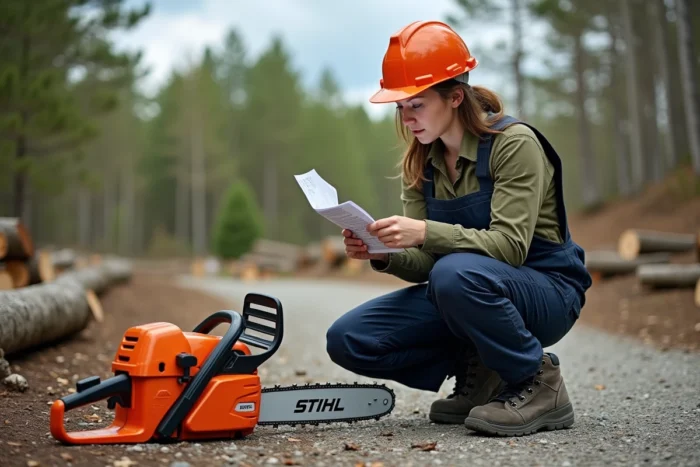
Personal protective equipment for using a Stihl chainsaw
The recent trend in communication from manufacturers and distributors places personal protective equipment at the same level of requirement for individuals as for professionals. A small displacement chainsaw presents the same cutting risks as a professional model.
Four pieces of equipment constitute the minimum required before any startup:
- Helmet with visor and integrated hearing protection, which protects against flying chips and the noise of the gas engine.
- Cut-resistant pants, whose long fibers block the chain in case of contact with the leg. Recent tests shared in videos by professionals in the wood sector demonstrate the effectiveness of this equipment, even on chains running at full speed.
- Reinforced protective gloves on the back of the left hand (the side exposed to the chain).
- Safety shoes or boots with cut-resistant protection and non-slip soles.
This equipment is not only relevant during the cutting phase. It must be worn from the starting phase, as the chain can start moving at the very first start if the brake is not properly engaged.
The starting sequence of a Stihl chainsaw relies on a logical mechanical chain: block the chain, reduce compression, enrich the mixture, pull, then weaken the mixture at the first combustion. Each model may present variations (presence or absence of a valve, type of combined control), and the user manual provided with the machine remains the reference for the specifics of your model.