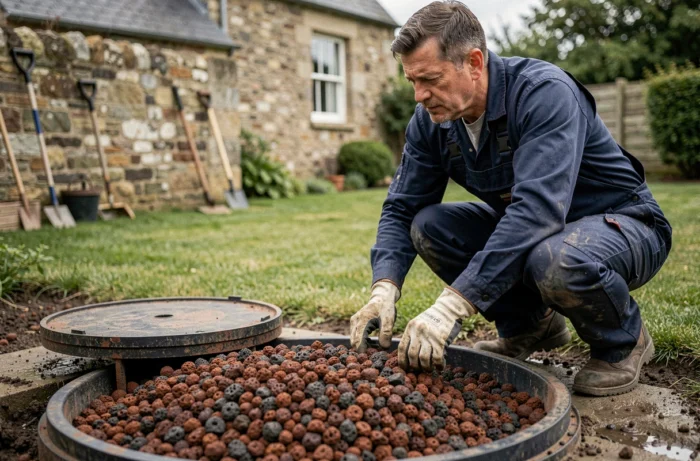
The pozzolana used as a prefilter for all-water tanks is not a filtering medium in the purifying sense of the term. Its role is limited to trapping suspended solids before they reach the downstream treatment device (drainage, sand filter, compact filter). Confusing prefiltration with treatment remains the most common mistake in non-collective sanitation installations.
Granulometry and specific surface area: what determines the performance of the pozzolana prefilter
The retention capacity of a pozzolana prefilter primarily depends on the chosen size. A granulation that is too fine accelerates clogging, while a granulation that is too coarse allows suspended solids to pass through without retaining them. We recommend a size between 40 and 80 mm for use at the outlet of all-water tanks.
The honeycomb texture of pozzolana gives it a specific surface area far superior to that of conventional gravel. These cells provide micro-habitats for aerobic bacteria that participate in the partial degradation of trapped organic matter. This is not strictly a biological treatment, but a measurable secondary effect when the prefilter is properly ventilated.
One point that popular articles overlook: the apparent density of pozzolana varies according to the deposit. Rocks from the quarries of Auvergne do not have the same porosity as those extracted in Ardèche. This difference directly affects the flow rate and the frequency of clogging. We observe in the field that prefilters clog well before the tank needs to be emptied, which requires a separate maintenance schedule.
To better understand the advantages and limitations of pozzolana in the context of sanitation, it is essential to distinguish its mechanical properties from its biological limits.
SPANC compliance and pozzolana prefilter: an often underestimated obligation
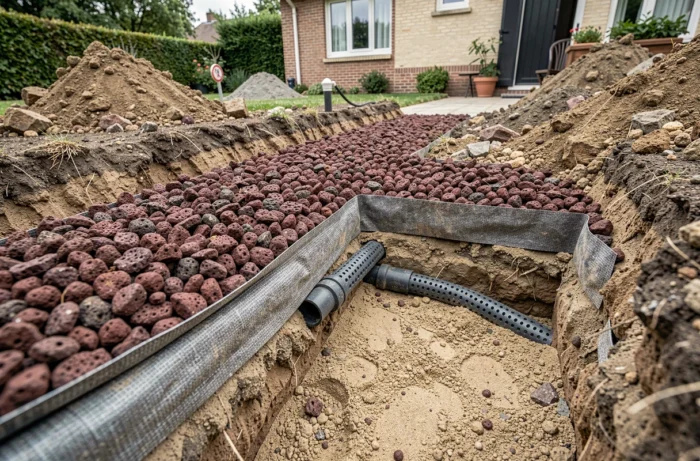
The decree of September 7, 2009, ended the isolated septic tank (only wastewater). All installations must now rely on a all-water tank coupled with a secondary treatment device. The pozzolana prefilter is interposed between these two elements, but it never constitutes a compliant system on its own.
During a SPANC inspection or a sanitation diagnosis before sale, a clogged prefilter can be enough to classify the installation as non-compliant. The consequences are concrete: work to bring it up to standard within the year following the real estate transaction.
Control points during a SPANC visit
- Condition of the prefilter: no visible clogging, non-compacted pozzolana, no crust formation on the surface
- Accessibility of the prefilter basket or tank for maintenance and replacement
- Correct connection between the tank outlet and the inlet of the downstream treatment device, without bypass or leaks
- Functional high ventilation, ensuring aeration of the prefilter and limiting odor rise
A pozzolana prefilter in good condition protects the downstream drainage or sand filter. A neglected prefilter accelerates the clogging of the treatment system, which means pushing the problem further down the line, with significantly higher rehabilitation costs.
Maintenance of the pozzolana prefilter: actual frequency and field protocol
The majority of manufacturers recommend annual cleaning. In the field, we find that the actual frequency depends on the volume of wastewater and the grease load. A family of four with a kitchen equipped with a grease trap can space out maintenance. Without a grease trap, the prefilter can clog in just a few months.
The cleaning protocol is simple but physically demanding. It involves removing the pozzolana from the basket, rinsing it with a water jet (never with a high-pressure cleaner, which destroys the honeycomb structure), and then putting it back in place. If the grains have fragmented or if the porosity has visibly decreased, replacement is necessary.
Signs of a pozzolana prefilter needing replacement
- Slowed outflow from the tank, with rising water level in the inspection chamber
- Persistent odors despite functional ventilation
- Fragile pozzolana grains, reduced to dust when touched
Replacing the pozzolana does not require professional intervention if the basket is accessible. We recommend storing a replacement volume equivalent to the basket to avoid leaving the tank operating without a prefilter for several days.
Pozzolana or plastic prefilter: selection criteria for a sanitation system
Plastic prefilters (sieve or cartridge type) have gradually replaced pozzolana in new installations in certain regions. Their cleaning is quicker and does not involve handling heavy loads. However, their contact surface with the effluents is lower, and they do not benefit from any biological effect.
Pozzolana still has a clear advantage on low-slope terrains, where the contact time between the effluent and the filtering medium must be maximized. Its durability is also superior: a properly maintained bed of pozzolana lasts several years without replacement, whereas a plastic cartridge deforms or cracks more quickly due to thermal variations.
The choice between the two also depends on the type of downstream system. A compact filter or a micro-treatment station tolerates suspended solids overloads less well than traditional drainage. In this case, pozzolana offers an additional safety margin due to its volumetric retention capacity.
The final decision is often made based on the terrain configuration and ease of access to the prefiltration inspection chamber. In an existing installation with a basket sized for pozzolana, changing technology implies modifying the inspection chamber, which is not always economically justified.