
Comparing pet insurance often comes down to comparing reimbursement promises. The real issue lies elsewhere: in the exclusions, waiting periods, and differences in veterinary fees that determine what you actually pay out of pocket. This article measures the gap between the advertised coverage and the actual protection, relying on available data for France.
Exclusions and waiting periods: what pet insurance does not cover
Most pet owners choose a plan by looking at the displayed reimbursement rate. This rate masks gray areas that can render the coverage unusable at the precise moment it is needed.
Dog or cat insurance contracts generally exclude several categories of care:
- Conditions that existed prior to enrollment, even if they have been stable or asymptomatic for a long time.
- Certain hereditary or congenital conditions, common in specific breeds like the French Bulldog or Cavalier King Charles.
- Diseases preventable by outdated vaccinations, which ties the validity of the coverage to strict adherence to the vaccination schedule.
- Convenience procedures (sterilization not indicated for medical reasons) and routine hygiene care.
The end of the waiting period does not automatically make a condition eligible. A declared or suspected condition during the waiting period may remain permanently excluded, even after this period expires. Reading the insurance product information document (IPID) before signing remains the only way to verify the actual extent of the guarantees.
To better understand the plans and guarantees offered in the French market, pet insurance on La Maison des Animaux details useful comparison criteria before any subscription.
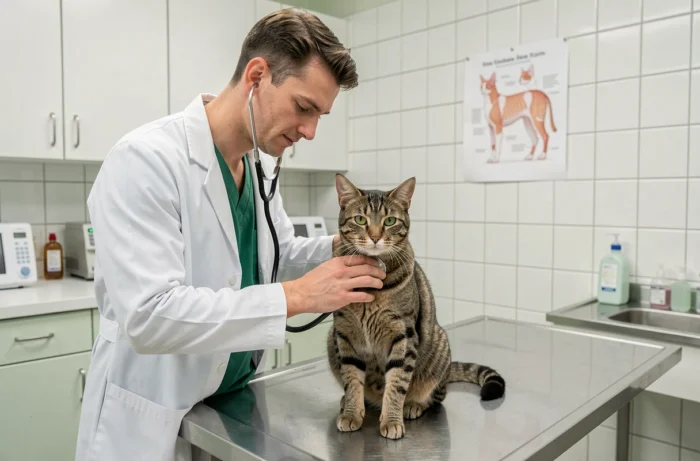
Differences in veterinary fees: why insurance is not enough
The Competition Authority has documented price differences between veterinary clinics in its opinion No. 25-A-12, adopted on October 13, 2025. The observed price differences between establishments for the same procedure show that pet health insurance, even with a good reimbursement rate, does not exempt one from comparing quotes.
The out-of-pocket expense depends on three combined variables: the fee charged by the clinic, the annual reimbursement cap of the contract, and any deductible. An insured owner at a clinic whose fees far exceed the reimbursement base may end up with a higher out-of-pocket expense than an uninsured owner at a clinic with moderate fees.
| Variable | Impact on out-of-pocket expense |
|---|---|
| Clinic fee | Determines the billed amount. Significant differences exist between establishments for the same intervention. |
| Annual cap of the contract | Sets the maximum reimbursement per year. Beyond that, all costs are borne by the owner. |
| Deductible per procedure or per year | Amount not reimbursed, deducted before calculating the reimbursement. Varies by plan. |
| Displayed reimbursement rate | Applies after the deductible is deducted and within the cap limit. Can give a false impression of coverage. |
The displayed rate is never the actual reimbursement rate. Two contracts at 80% can produce very different reimbursements if their caps and deductibles differ.
Changing insurers and loss of coverage
Changing insurance for your dog or cat carries a risk that is often underestimated. The seniority acquired with the previous insurer disappears. A new waiting period applies upon enrollment, during which the animal is not covered for illnesses.
If the animal developed a condition during the first contract, the new insurer may consider it a pre-existing condition and exclude it. Changing insurers, even motivated by a cheaper premium, can therefore create a gap without effective coverage.
Coverage rates in France and comparison with Sweden
France remains a country where the majority of pets are not insured. This situation contrasts with Sweden, where dog insurance is described as very widespread. The gap is not solely explained by the price of contracts.
National habits, the perception of financial risk associated with veterinary care, and the level of information among owners play a decisive role. In Sweden, insuring one’s pet is as much a cultural reflex as it is an economic calculation.

In France, pet insurance is still seen as an additional cost rather than a risk management tool. This perception hinders subscriptions, even as veterinary costs rise and available care becomes more sophisticated.
What the low coverage rate implies for French owners
Without insurance, an accident or serious illness confronts the owner with a choice between the cost of care and the health of their companion. Pet health insurance plans, despite their limitations, allow for spreading this financial risk over time.
The real calculation is not premium versus reimbursement, but the ability to finance a serious unforeseen event. An owner who can absorb a veterinary bill of several hundred euros without difficulty does not have the same need as a household on a tight budget.
Criteria for choosing pet insurance for dogs or cats
Three elements deserve particular attention before subscribing to a contract for your pet:
- The annual reimbursement cap, which conditions the actual coverage much more than the displayed rate.
- The list of exclusions (breeds, hereditary conditions, pre-existing conditions), to be checked in the IPID of the contract.
- The maximum age for enrollment and renewal conditions, as some insurers refuse animals beyond a certain age or significantly increase the premium as they age.
Comparing plans solely based on the monthly premium often leads to choosing a contract with too narrow guarantees. The cheapest premium is not always the one that best protects your pet or your budget in case of significant care.
The data that ultimately matters is neither the reimbursement rate nor the monthly premium taken in isolation. It is the maximum out-of-pocket expense in the event of a serious claim, relative to the household’s financial capacity. It is on this figure that a pet insurance contract makes – or does not make – sense.