Bamboo torture is one of those tortures whose mere description evokes horror. A slow and stubborn plant shoot that penetrates a immobilized human body: the story has circulated for centuries in Asian chronicles and Western colonial narratives. However, no solid archival source attests to a routine use of this practice. Between a tenacious myth and botanical reality, the subject deserves careful examination.
Bamboo Torture: Why Historiography is Doubtful
Before describing the method, a preliminary question must be posed: did this torture really exist as it is told? Recent historiography leans towards caution.
Studies on famous but dubious tortures, such as the iron maiden analyzed by Wolfgang Schild, show a clear trend. Several emblematic torture instruments are now reclassified as later constructions built on unverified accounts from the 18th and 19th centuries. Their notoriety rests on a chain of unverified repetitions, amplified by museums and popular culture.
Bamboo torture follows exactly this pattern. There are no judicial records, no corroborated contemporary testimonies, nor any investigative reports comparable to those that exist for other documented practices. A frequently cited text comes from a “civilian from Madras” published during the British colonial era, but this isolated account does not constitute archival proof.
To learn more about execution by bamboo, one must cross-reference sources with this critical reading framework.
Bamboo as a torture tool has been mentioned in China, India, and especially Japan. But in each case, the mentions remain vague, late, or reported by external observers.
Bamboo Growth and the Principle of the Described Method
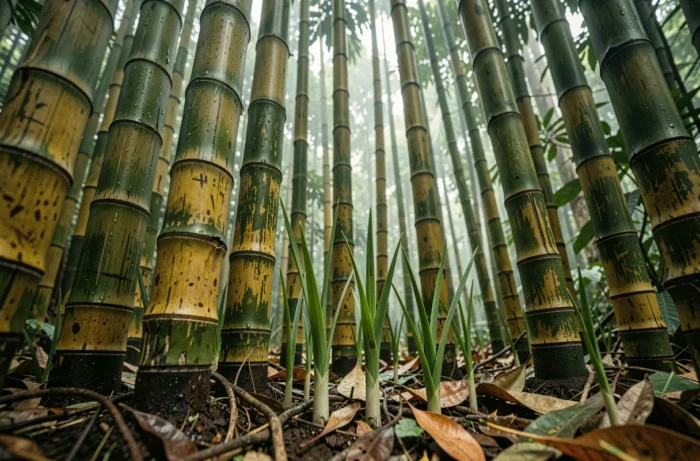
Why bamboo, and not another plant? The answer lies in its biology. Some species of bamboo are among the fastest-growing plants in the world. Certain shoots can grow several centimeters per hour under favorable conditions.
The principle of the torture as described exploits this property. The victim was supposedly immobilized above a young bamboo shoot sharpened to a point. Within a few hours, the growing stem would exert enough pressure to penetrate human tissues.
What Botany Confirms
The mechanical force of a growing bamboo shoot is real. Experiments, including one aired by MythBusters, have shown that a bamboo shoot can indeed penetrate soft materials as it grows. The plant exerts constant and continuous pressure, without jerks, which theoretically makes it capable of penetrating biological tissues over an extended period.
This point is often confused with historical proof. The fact that bamboo can physically pierce a body does not mean that this method was systematically used as a mode of execution.
Colonial Narratives and War Propaganda: Available Sources
The most detailed accounts of bamboo torture come from two specific contexts.
- British colonial chronicles in India, where administrators report the practice as a local custom, without ever providing direct testimony or official records
- Allied propaganda during World War II, which attributed this torture to Japanese soldiers in Pacific prisoner camps
- Accounts related to the Vietnam conflict, where bamboo torture appears in testimonies that are difficult to corroborate with material evidence
In each case, the narrative serves a purpose: to describe the adversary as barbaric. This context does not render the testimonies false by principle, but it imposes a critical reading. Historians working on wartime violence have much more substantial records for other practices: photographs, medical reports, documented confessions during trials.
For bamboo torture, this corpus does not exist. We remain in the realm of transmitted narrative, never in that of material proof.
Myth or Reality: What the Distinction Changes
Whether bamboo torture existed sporadically or is a complete myth, the question is not merely academic. It sheds light on how societies construct their narratives of violence.
The Mechanism of the Black Legend
The most famous tortures are often the least documented. The iron maiden, the brazen bull, bamboo: all share a common pattern. A spectacular device, a cruel mechanism easy to visualize, and an attribution to a “different” people or era.
This mechanism works because it meets a narrative need. It allows for a boundary to be drawn between “us” (civilized) and “them” (barbarians). Colonial narratives about bamboo in Asia fulfill exactly this function.
What is Documented Elsewhere
Practices of torture that are actually attested in conflicts in Southeast Asia are, on the other hand, abundantly documented. Verified violence is often less spectacular but better proven than legendary accounts.

This distinction between real violence and mythologized violence does not minimize anything. It reminds us that documentary rigor remains the only reliable tool for addressing the history of tortures, including the most extreme.
Execution by bamboo remains a fascinating subject for the history of mentalities. Its persistence in the collective imagination likely says more about the psychology of those who transmit the narrative than about the actual practices of the societies to which it is attributed.