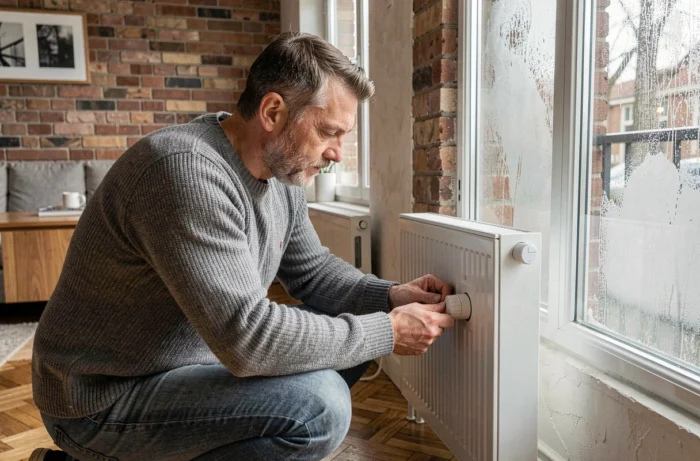
A radiator running at full blast in a living room while the bedroom remains icy, a gas bill rising without explanation, maintenance postponed year after year: in Brussels apartments, the same heating mistakes keep recurring. They are costly, degrade comfort, and, with the tightening of PEB requirements in the Brussels Region, they can also complicate the resale or rental of a property.
PEB thresholds in Brussels: why heating is no longer considered in isolation
We often tend to choose or replace a boiler by only looking at the annual bill. The Brussels PEB trajectory makes this approach outdated. Since the ordinance of March 7, 2024, supplemented by a ministerial decree published in March 2026, every dwelling must remain below 275 kWh/m² per year by January 1, 2033, which is at least an energy class E.
In the longer term, the goal drops to 150 kWh/m² per year (class C). Installing a high-performance system in a poorly insulated apartment is like heating with the windows open: the boiler compensates, consumption skyrockets, and the PEB certificate remains poor.
The concrete mistake is often seen in buildings in the municipalities of Saint-Gilles or Woluwe-Saint-Lambert: a homeowner replaces their old gas boiler with a condensing model without touching the thermal envelope. There is a gain on the bill, but the dwelling remains far from regulatory thresholds. Anticipating common heating mistakes in Brussels starts with a cross-reading of the PEB and the sizing of the installation.
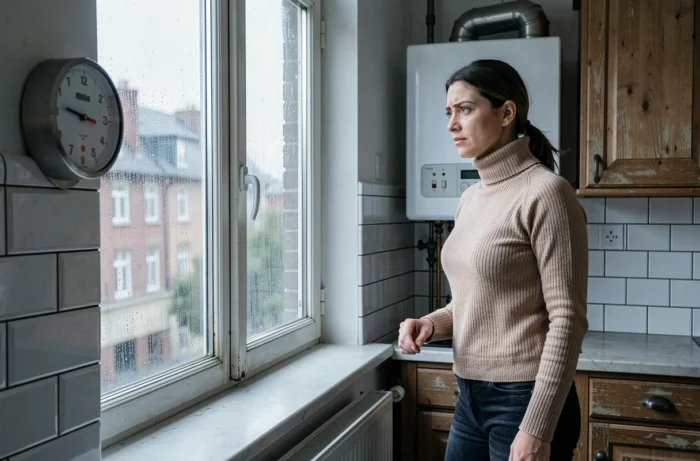
Gas or oil boiler in Brussels: what the ban changes for existing apartments
Brussels now prohibits new gas and oil boilers in new buildings since 2025. For existing apartments, one can still replace a failing boiler with a gas model, but the window is closing. Investing today in a fossil boiler commits for fifteen to twenty years, a duration that overlaps with future restriction stages.
The frequent mistake: replacing like for like without considering the alternative. In an apartment with a high-temperature radiator network, switching to an air-water heat pump often requires revising the heat emitters. Feedback on this point varies depending on the building’s configuration and the condominium’s agreement. This is a discussion to have with a heating technician before signing a quote, not after.
Condominium and collective gas heating
In many Brussels buildings, heating is collective. Changing the energy source requires a vote in the general assembly and a global sizing. A single co-owner cannot decide to switch to an individual heat pump if the common network supplies the entire building.
The trap: waiting for a breakdown of the collective boiler to start the discussion. At that point, the condominium is under pressure, the repair is costly, and the chosen solution is rarely the most suitable for the long term.
Mandatory boiler maintenance: deadlines that tenants ignore
In the Brussels Region, maintenance of a gas boiler is mandatory every two years, and annually for an oil boiler. Failing to meet these deadlines exposes one to penalties, but more importantly, to a gradual degradation of efficiency and a risk of carbon monoxide poisoning.
On the ground, many tenants believe that maintenance is solely the landlord’s responsibility. The distribution depends on the lease and the type of contract, but in most cases, routine maintenance falls to the tenant. Waiting for the landlord to take the initiative means losing one or two maintenance cycles.
- Check the date of the last maintenance upon entering the apartment (request the certificate)
- Schedule an annual or biannual reminder depending on the fuel used
- Keep each inspection certificate: it is required in case of a claim or compliance check
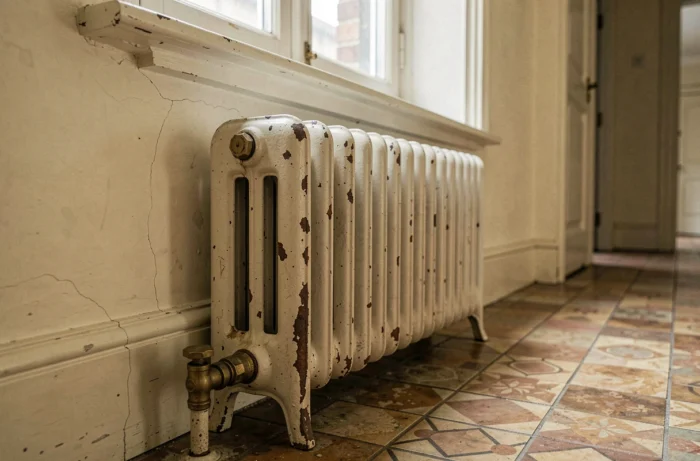
Thermostat and thermostatic valves: settings that inflate the heating bill
Turning the thermostat up to 25 °C to heat faster does not work: the boiler does not heat harder, it heats longer. You end up with an overheated living room and an inflated bill, without gaining real comfort in the distant rooms.
Every additional degree significantly increases consumption. The recommended temperature for a living room is around 20-21 °C, and between 16 and 18 °C for bedrooms at night.
Poorly used thermostatic valves
Thermostatic valves on radiators allow for temperature modulation room by room. The classic mistake: opening them all to the maximum and regulating only via the central thermostat. The result is uniform heating throughout the apartment, including in unoccupied rooms.
- Set the valves in living areas to 3 or 4, those in bedrooms to 2
- Close the valves in unoccupied rooms during the day (empty office, guest room)
- Never completely close a radiator in a damp room, to avoid condensation on the walls
Water leak and circuit pressure: signals not to ignore
A boiler that repeatedly goes into safety mode often signals a pressure problem in the circuit. When the pressure drops below 1 bar, the system stops. Conversely, too high a pressure may indicate a faulty expansion tank or a leak somewhere in the radiator network.
A slow leak on a radiator connection can go unnoticed for months, until a moisture stain appears on the neighbor’s ceiling. In an apartment, damage spreads quickly between floors.
Before calling a repair service, one can check the boiler’s pressure gauge oneself. If the pressure is low, fill the circuit via the filling valve until reaching the range indicated by the manufacturer (usually between 1 and 1.5 bar). If the pressure drops again in a few days, it is a sign of a leak that requires a heating technician’s intervention.
Heating in a Brussels apartment is not just about choosing equipment. It is a combination of settings, maintenance, and decisions that fit within an increasingly strict regulatory framework. It is better to correct these mistakes now than to discover them during a PEB audit or a breakdown in the middle of winter.