A timing belt to replace, worn brake pads, or a technical inspection to pass: when the budget is tight, the bill from a traditional mechanic can become an obstacle to daily mobility. Solidarity garages offer a concrete alternative for repairing your car at a low price, with professional oversight. However, it is essential to know how they operate, who can benefit from them, and what they actually cover.
Reduced rates at solidarity garages: what explains the price difference
Competitors often detail the services offered or the locations of the garages. Before that, it is necessary to understand the economic mechanism that makes these rates possible.
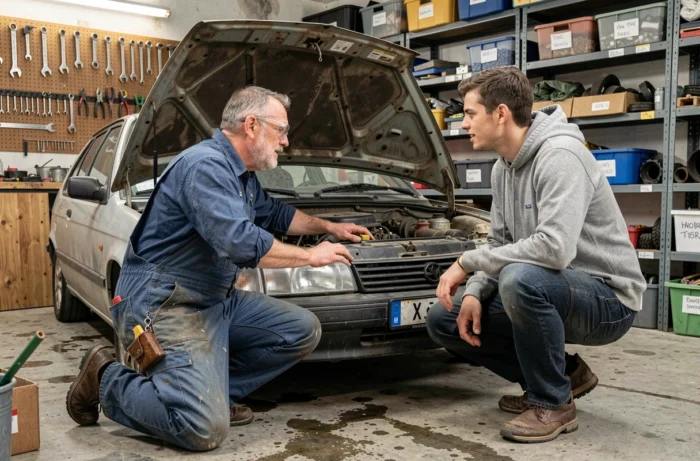
A solidarity garage most often operates under an associative status. It does not generate commercial profit. Labor costs are absent or very low, as repairs are carried out by employees in training, supervised volunteers, or directly by the vehicle owner with the help of a professional.
Spare parts often come from donated vehicles that are dismantled on-site. This reuse circuit reduces the cost of parts compared to retail prices. Some garages also receive funding from local authorities or the state, allowing them to maintain a baseline price for common interventions.
A regularly updated directory is available at garages-solidaires.fr, which lists the structures by department along with their contact details and the types of services offered.
The result: an oil change, a battery replacement, or a brake repair costs significantly less than at a traditional garage. The difference can reach half of the usual price, sometimes more depending on the intervention and the availability of reused parts.
Access conditions: who can benefit from a solidarity garage
Wondering if you are eligible? The answer depends on each structure, but there is a common foundation.
Solidarity garages cater to people in precarious situations: recipients of RSA (Active Social Income), job seekers, low-income workers, temporary workers. Access criteria generally depend on family quotient or declared resources.
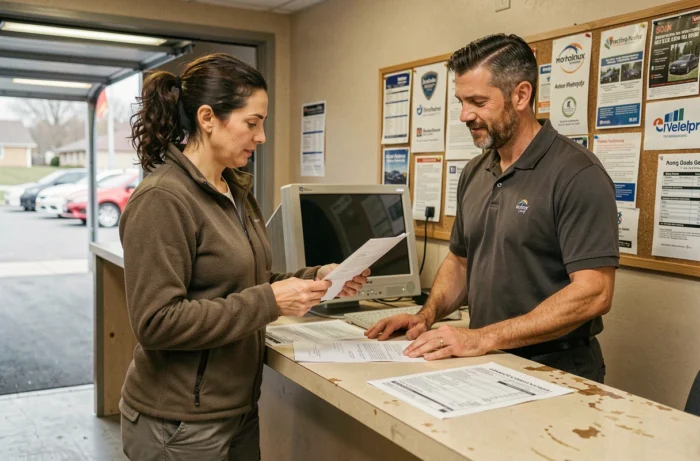
Referral often goes through a social worker, a local mission, a Pôle emploi (France Travail) advisor, or an integration structure. Some inclusive mobility platforms now integrate the solidarity garage into a broader pathway. The TIMS program (Territories and Solidarity Mobilities) has supported 327,000 people towards adapted mobility solutions by the end of 2025, including diagnostics, workshops, and repairs.
This referral through a social prescriber is not just an administrative formality. It allows for verifying eligibility and sometimes mobilizing additional assistance (mobility grant, microcredit for purchasing parts).
Specific case of temporary workers
The FASTT (Social Action Fund for Temporary Work) offers specific access to low-cost vehicle repairs for temporary workers, through a network of partner garages spread across the territory. Access is made directly from their service platform, without going through a traditional social prescriber.
Repairing your own car: how the self-garage works
The solidarity garage is not limited to handing over your vehicle to a mechanic. Many structures offer a participatory mode, sometimes called a self-garage, where the owner intervenes themselves.
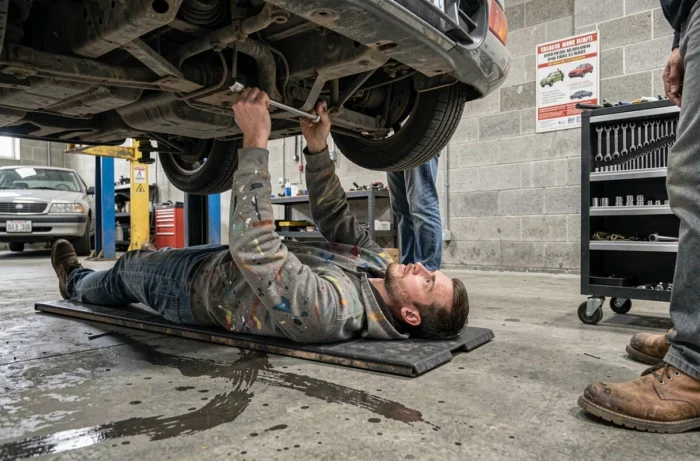
Specifically, you rent a lift, access professional tools, and benefit from the advice of a mechanic present on-site. This format is suitable for common operations:
- Engine oil change and filter replacements (oil, air, cabin), achievable in less than an hour with basic support
- Brake pad, disc, or drum replacement, provided you follow the instructions of the professional present
- Battery, bulb, wiper blade, or small wear part replacement
- Visual diagnostics before technical inspection, to identify likely refusal points and prioritize repairs
The support of a professional on-site distinguishes the self-garage from simple DIY. The mechanic checks critical interventions (braking, steering, suspension) and can take over if the manipulation exceeds the owner’s skills.
Significant savings are possible. By eliminating labor costs, the price of the intervention is limited to parts and the rental of the workspace.
Solidarity garage and inclusive mobility: a link in a broader pathway
Low-cost repairs do not solve everything. A repaired vehicle is useless without a license, affordable insurance, or fuel. Solidarity garages are increasingly part of an inclusive mobility ecosystem.
Some structures also sell solidarity-priced used cars, sourced from donations by individuals. The Solidarauto network, for example, collects donated vehicles, refurbishes them through its garages, and sells them at low cost to eligible individuals.
At the same time, local collectives are experimenting with solidarity car-sharing between individuals, especially in rural areas where the lack of public transport makes a car necessary. These initiatives complement the solidarity garage by offering temporary access to a vehicle when repair is not the only barrier.
Social services that provide direct referrals
Institutionalization is progressing. Platforms like Dora, used by public integration services, now reference solidarity garages alongside other support services. The solidarity garage is becoming a common mobility service, no longer a marginal initiative reserved for insiders.
This integration facilitates access for potential beneficiaries. A France Travail advisor or a social worker can directly refer you to the nearest structure, with an up-to-date list of available services.
To find a solidarity garage near you, the starting point remains the social prescriber in your area. Communicate your situation, your repair needs, and your budget. Referral by an integration professional remains the most reliable way to access the right system, at the right price, without missing out on additional assistance you may be entitled to.