
The transfusion of red blood cell concentrates (RBC) in patients over 70 years old represents a growing share of transfusion activity. The prevalence of anemia increases with age and affects up to half of patients in acute geriatrics. Here, we address the technical points that condition the safety of this procedure in this population.
Transfusion thresholds in elderly patients: what the MINT trial changes
The restrictive strategy (threshold of 7 to 8 g/dL of hemoglobin) has dominated practice since the HAS recommendations of 2014. This approach remains relevant for the majority of common geriatric indications, but it shows its limits in an acute cardiological context.
The MINT trial, published in the New England Journal of Medicine in 2023, compared a liberal strategy (maintaining Hb above 10 g/dL) and a restrictive strategy in patients presenting with anemia due to myocardial infarction. The results show a trend towards a reduction in the combined risk of death or new infarction at 30 days with the liberal strategy, even though the classic threshold of statistical significance was not crossed.
The AABB 2025 recommendations now incorporate this data. They qualify a transfusion threshold of 10 g/dL in patients with myocardial infarction as “reasonable.” We observe here a notable shift from previous practices, which uniformly applied the restrictive threshold regardless of cardiac comorbidity.
In practice, this means that the cardiologist and geriatrician must discuss on a case-by-case basis. Applying a threshold of 7 g/dL in an 82-year-old patient in the acute phase of an infarction exposes them to potentially harmful undertreatment. Current data on blood transfusion in seniors on Pharmactuelle confirms the need to adapt the decision to the individual clinical profile.

TACO: the leading cause of transfusion-related mortality in seniors
TACO (transfusion-associated circulatory overload) remains the most feared complication. It is the leading cause of transfusion-related mortality in France, and patients over 70 years old constitute the primary target.
Hemovigilance data is explicit: out of the 235 serious adverse effects (SAE) of TACO type reported in 2017, 155 involved recipients over 70 years old, accounting for 66% of cases. Among them, more than a third resulted from non-compliance with recommendations.
Identified factors of non-compliance
- Number of RBC transfused in a single sequence too high, without clinical reassessment between each unit
- Transfusion duration too rapid, particularly in patients with pre-existing heart failure (about 40% of those over 80 have a cardiovascular condition)
- Absence or insufficiency of clinical evaluation after the first RBC, preventing early detection of volume overload
One RBC, one evaluation, then a decision for the next: this sequence should be systematic for any patient over 70 years old. The recommended infusion rate does not exceed 5 mL/min in a patient at risk of overload. Lung auscultation and blood pressure measurement after each bag remain the simplest barrier gestures against TACO.
Etiological assessment of anemia: a prerequisite too often incomplete
Transfusing without investigating the cause of anemia amounts to treating a symptom while ignoring the disease. In the elderly, the etiologies of anemia are often multifactorial, making the assessment more complex but no less necessary.
The classic distribution distinguishes between deficiency anemias (iron, B12, folates), chronic inflammatory anemias, and anemias due to bone marrow insufficiency. A significant number of cases remain unexplained after standard assessment, sometimes labeled “anemia of the elderly” by default.
We recommend a systematic minimal assessment before any first scheduled transfusion:
- Ferritin level and transferrin saturation coefficient, to distinguish true iron deficiency from inflammatory iron sequestration
- Measurement of vitamin B12 and serum folates, particularly in patients on long-term proton pump inhibitors
- CRP and serum protein electrophoresis, to guide towards an inflammatory or hematological cause
- Creatinine level and estimated clearance, as chronic kidney insufficiency is a frequent factor in anemia due to erythropoietin deficiency
A complete etiological assessment reduces the need for iterative transfusions. A patient whose iron deficiency is corrected through oral or intravenous supplementation does not return every three weeks to the day hospital for a new RBC.
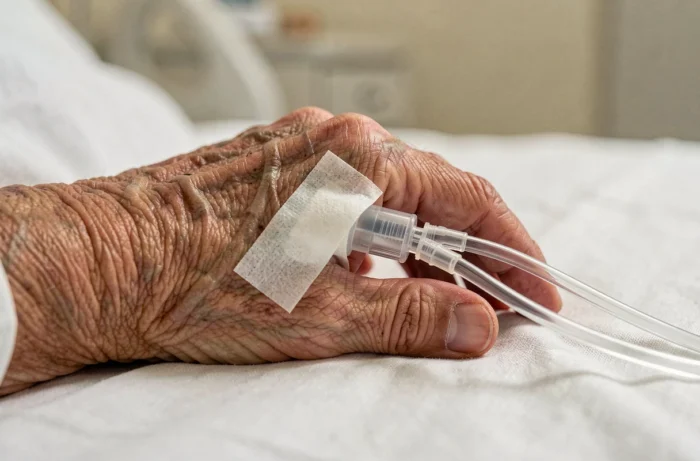
Geriatric frailty and transfusion decision-making
The notion of frailty profoundly alters the benefit-risk equation. Anemia itself is a marker of frailty: it worsens loss of autonomy, increases the risk of falls, and contributes to cognitive decline. Transfusion can therefore break a functional vicious circle.
On the other hand, a frail patient tolerates volume overload less well and has reduced cardiopulmonary reserves. The therapeutic window narrows. It is precisely in this population that the transfusion threshold must be individualized, neither systematically restrictive nor blindly liberal.
The standardized geriatric assessment (frailty score, ADL/IADL autonomy, nutritional status) should be included in the transfusion record just like blood group and the search for irregular agglutinins. Adapting the threshold to the frailty profile rather than to chronological age constitutes the shift that practices must take.
Healthcare facilities that integrate a geriatrician into the transfusion prescription circuit observe a decrease in TACO and a better alignment between indication and actual need. Coordination between geriatrics, hemovigilance, and hematology services remains the most effective lever to secure transfusion in elderly recipients.