
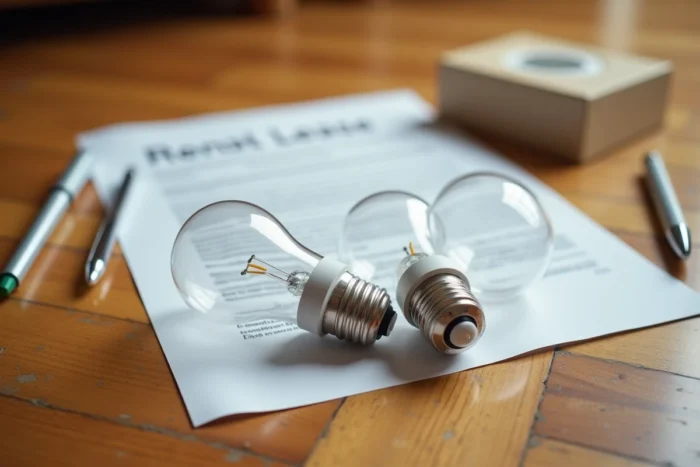
You empty the boxes, disassemble the shelves, and just as you are about to unscrew the last bulb from the ceiling light, doubt creeps in. This LED bulb you bought two years ago, does it belong to you or does it stay with the property? The answer depends less on a specific legal text than on how French law classifies the elements of a dwelling.
Bulbs and the rental repair decree: the distinction that matters
No French law explicitly mentions bulbs as an item to leave or take when moving. The closest text on the subject remains the decree n° 87-712 of August 26, 1987, which lists the rental repairs that are the responsibility of the tenant.
This decree classifies the replacement of bulbs among minor routine maintenance repairs. Throughout the duration of the lease, it is therefore the tenant’s responsibility to replace a burnt-out bulb, just as they would replace a faucet washer. As detailed by the information from the 100,000 Watts website, this maintenance obligation does not mean that the tenant must leave their bulbs behind when they move out.
The nuance can be summarized in one sentence: the bulb is a consumable, not a fixed fixture of the dwelling. A socket screwed into the ceiling is part of the electrical installation. The bulb you insert into it is not. It is more akin to a roll of toilet paper than to a sink.

Decent housing without bulbs: what the law of July 6, 1989 says
Article 6 of the law of July 6, 1989, requires the landlord to provide decent housing. This obligation particularly covers a safe electrical installation: grounded outlets, protection against electric shocks, absence of bare conductors.
Bulbs are not included in the criteria for decency. A dwelling can therefore be legally considered decent without a single bulb in place, as long as the sockets, circuits, and protections are compliant.
Have you ever noticed that some new homes are delivered without lighting? This is exactly this principle in action. The developer installs the light points (the sockets, the DCL outlets), but not the bulbs or fixtures.
Outgoing tenant and incoming tenant: two distinct situations
As an outgoing tenant, nothing legally compels you to leave your bulbs. As an incoming tenant, you cannot demand that the landlord provide them.
The only real obligation concerns the condition of the electrical installation at the beginning and end. If the entry inventory mentions bulbs in place and functional, their absence during the exit inventory may be noted as damage.
Exit inventory: the real point of contention over bulbs
It is during the inventory that the question becomes concrete. The comparative document between entry and exit serves as a reference. Three scenarios arise:
- The entry inventory does not mention bulbs (or indicates bare sockets): you have no obligation to leave any. The dwelling is returned in the state in which you found it.
- The entry inventory mentions functional bulbs: you must return working bulbs, not necessarily the same models, but bulbs that function.
- You installed a fixture (suspension, decorative ceiling light) on a lighting point that did not have one: you can remove it, provided you return the socket or DCL outlet to its original state.
A practical tip: reread your entry inventory before you start taking everything apart. This document takes precedence over any verbal discussion with the landlord.
Withholding from the security deposit for missing bulbs
A deduction for absent bulbs is theoretically possible if the entry inventory mentioned them. In practice, the amount is so low that few landlords take the risk. The cost of a standard LED bulb is just a few euros.
The real risk does not concern the bulbs themselves, but the associated damages. A wire torn while removing a fixture, a broken socket, a missing DCL outlet cover: these elements fall under the electrical installation and may justify a more significant deduction.
Real estate sale and bulbs: the rules change
The case of a sale follows a different logic than that of a rental. In a real estate transaction, the distinction is made between movable property and immovable property by destination.
A fixture fixed to the wall or ceiling (wall lamp, recessed spotlight, screwed ceiling light) can be considered immovable by destination. This means it is supposed to remain in the property during the sale, unless otherwise stated in the sales agreement.
The sales agreement or promise must precisely list what the seller is taking. If nothing is specified, everything that is fixed to the structure is deemed sold with the property. This is a frequent source of disputes between buyer and seller.
- Antique chandelier in the living room: must be mentioned in the agreement if the seller wants to keep it
- Recessed lights in the false ceiling: considered immovable by destination, they remain
- Floor lamp placed in a corner: movable property, the seller takes it without formality
- Bulbs screwed into sockets: consumables, their fate has no legal value in the transaction
The notary can clarify these points when drafting the deed. It is better to address the issue of fixtures as soon as the sales agreement is signed rather than discovering torn ceiling lights on the day of the key handover.
The question of bulbs when moving ultimately comes down to one reflex: check the entry inventory for rentals, check the agreement in the case of a sale. The bulb itself has almost no legal value, but the installation it connects to does. The most useful precaution remains to photograph each light point before and after the move, to cut short any disputes.