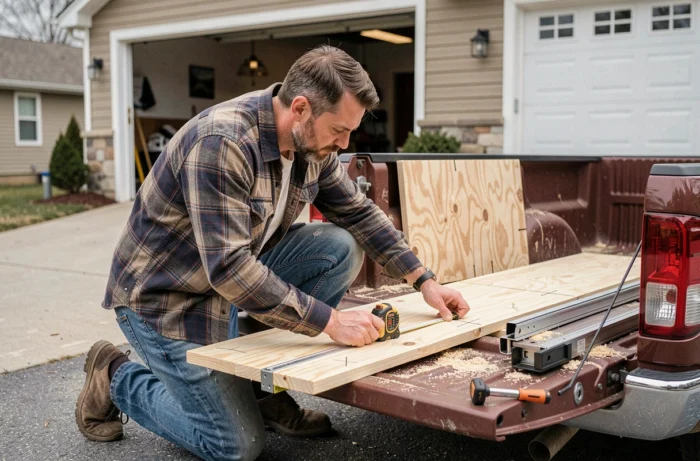
A sliding tray for a pickup addresses a concrete problem: accessing the back of the bed without crawling or contorting. Commercial solutions exist, but their price drives many pickup owners to create their own system. The choice of materials, the type of sliding mechanism, and especially the attachment to the bed determine the long-term reliability of the result.
Sliding without rails: an underestimated approach for a pickup sliding tray
Most guides focus on ball-bearing slides or telescopic rails. A simpler alternative exists, documented by feedback from Mitsubishi L200 users: a high-density polyethylene (HD 1000) tray that slides directly on the bottom of the bed, without any rails.
The HD 1000 has a very low coefficient of friction. The tray moves laterally guided by the wheel wells and then by wooden boxes fixed on the sides. Nothing is screwed to the bed; everything can be set up in a few minutes. This type of setup is suitable for light everyday loads, not for transporting heavy equipment.
The advantage of this approach is twofold. First, the cost remains minimal with reclaimed materials. Second, the absence of permanent fixtures preserves the original bed, which is important for the resale of the vehicle. Those looking for a guide for a homemade pickup sliding tray will find this method an accessible starting point before considering a more elaborate system.
However, recent field feedback indicates some limitations: on tracks or degraded roads, a tray without locking can move on its own due to vibrations. Planning for at least a rear stop or a locking latch reduces this risk.
Telescopic rails and slides: choosing the right system for the bed
When the tray must support significant loads (tools, construction materials, camping equipment), ball-bearing slides become the only reliable option. The choice of rail conditions the entire project.
Load capacity and stroke length
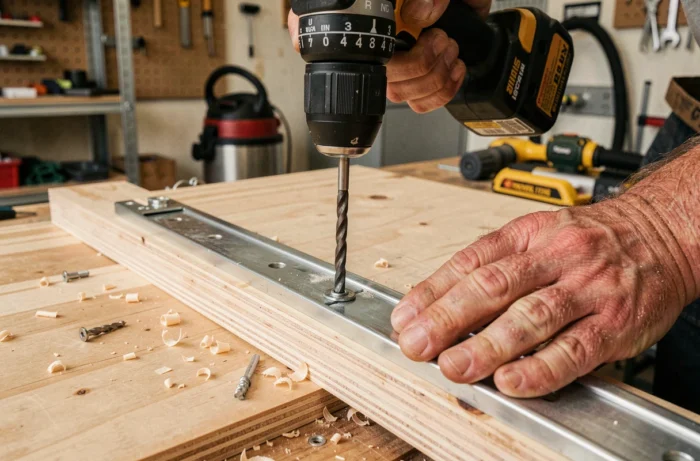
Slides sold in hardware stores for kitchen drawers cannot withstand the stresses of a bed tray. Industrial full-extension slides are necessary for the tray to fully extend from the bed and support the expected weight. One-meter rails fixed to the bed’s anchor points are a common base.
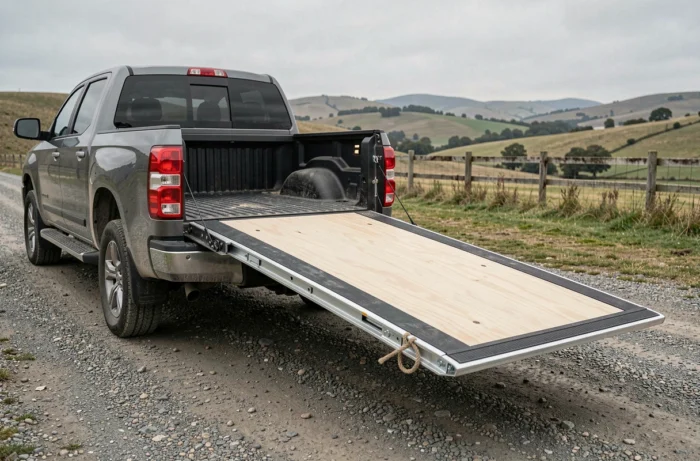
The stroke length, meaning the distance the tray can extend, must correspond to the usable depth of the bed. A tray that only extends two-thirds of the way still requires bending to reach the bottom.
Attachment to existing anchor points
Pickup beds have anchor points designed for securing loads. Using these points to attach the rails avoids drilling into the metal and preserves the watertightness of the bed. If drilling is necessary, a silicone seal or a waterproof rivet prevents water from infiltrating the chassis.
- Check the spacing of the anchor points and compare it to the spacing of the chosen rails before any purchase
- Use bolts with large washers to distribute the load on the bed’s metal
- Plan for rust treatment on each drilled hole, even with galvanized steel
Wood or metal tray: decide based on actual use
Marine plywood remains the most commonly used material for DIY trays. It cuts easily with a circular saw, sands well, can be treated, and offers a good balance between weight and rigidity. A good thickness of plywood withstands moderate loads well while still being manageable by one person.
Aluminum, on the other hand, provides superior corrosion resistance and a lower weight at equal rigidity. Working with aluminum requires suitable tools (metal saw, riveter, drill with specific bits) and some experience. For a first project, wood is more forgiving of measurement or cutting errors.
A often overlooked point: the surface of the tray must prevent the sliding of objects placed on it. A non-slip coating (rubber mat, textured paint) prevents the load from shifting during braking. Without this treatment, the sliding tray solves the access problem but creates another.
EN 12195 standard and securing: what DIYers forget
Building a sliding tray for your pickup is DIY, but driving with it falls under the highway code. The family of EN 12195 standards governs the securing of loads on all road vehicles in the European Union, including light utility vehicles modified in a homemade manner.
During roadside checks, the straps or chains used to secure the load on the tray must bear a readable label indicating their capacity (LC) and their tension force (STF). Straps without markings are considered non-compliant, which can lead to a fine and the immobilization of the vehicle.
The tray itself, if not securely fastened to the bed, can be considered an unsecured load. Field feedback varies on this point: some users have been driving for years with a tray simply placed, while others have been fined during a check. Planning a locking system that secures the tray in the closed position during driving eliminates this ambiguity.
- Use only straps and hooks that bear markings compliant with the EN 12195 standard
- Secure the tray to the bed with at least two locking points in the driving position
- Ensure that the tray does not extend beyond the rear tailgate when in the closed position
A well-designed sliding tray transforms the daily use of a pickup. The choice between a simple system without rails and a setup on industrial slides depends on the weight transported and the frequency of use. In any case, the securing of the tray and the load deserves as much attention as the construction itself.